Why event floristry is difficult to cost and explain
Clients mainly see the flowers at an event, while florists deliver a complete project – from concept and materials to logistics, installation and removal. This article explains why a responsible quotation covers far more than the visible blooms.
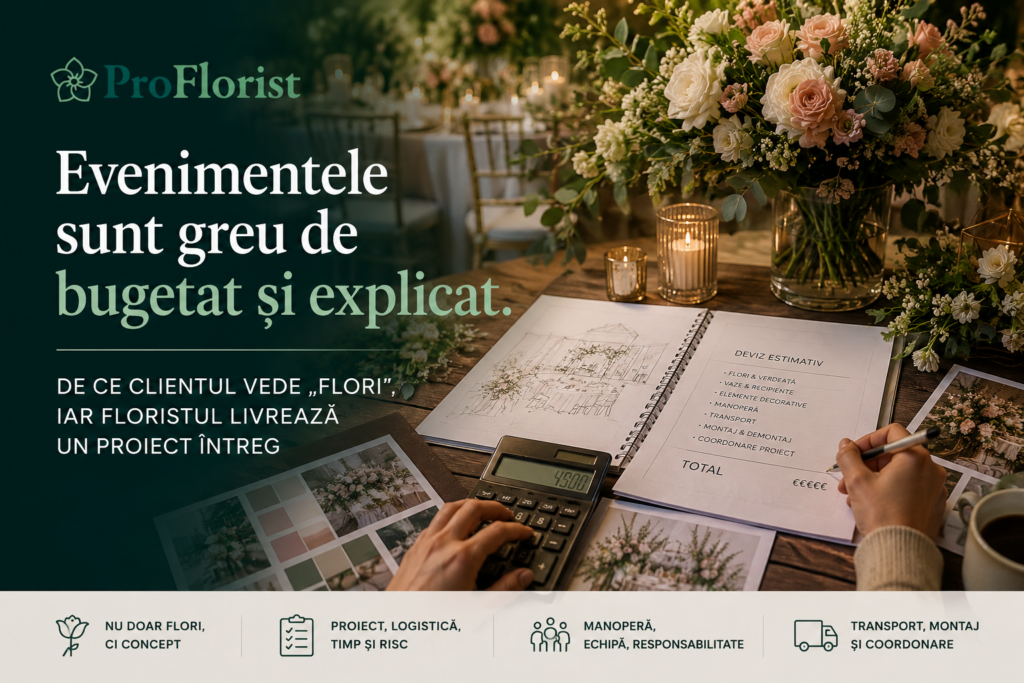
In floristry, one of the most difficult conversations between the client and the florist is the one related to the event budget. Whether we are talking about the wedding, baptism, anniversary, corporate event or product launch, the floral decoration seems, at first glance, easy to understand: “a few flowers on the tables,” “an arch,” “a bridal bouquet,” “some candles” or “a little green.”
In reality, a floral event is not just flowers. It involves concept development, material selection, ordering and conditioning, logistics, transport, team, assembly, time, risk, responsibility and dismantling. And all this needs to be budgeted correctly, explained clearly and assumed by both sides.
This is where one of the biggest tensions in the industry appears: the customer sees the final product, but the florist knows everything behind that result.
Why prices cause so much confusion
Public discussions about flowers and wedding decoration show a very clear reality: customers compare very different offers without always having the necessary benchmarks to understand what each contains.
A client may receive a quotation for flowers and decoration at a wedding in Bucharest and initially consider the total high. But if the interior and garden decor, meals, top table, arcade, entrance, flowers for the venue, greenery, decorative bottles, lanterns, transportation, assembly and team on the day of the event, the discussion becomes completely different.
A wedding with 130 people doesn’t mean “a few meals.” It means, often, about 13 guest meals, plus the mass of the groom, the ceremony area, the entry area, candles, bouquets, piglets, floral accessories, can decorate for candy bar, welcome corner or photo corner.
Each element adds time, materials, people and responsibility.
The question is not simply: “How much are the flowers?”
In events, the question “How much do flowers cost?” is almost always incomplete.
The right question would be:
How much does a complete floral concept, built for a particular location, on a given date, with a certain number of guests, with certain flowers, a certain complexity, a certain level of assembly and a certain responsibility on the day of the event?
The florist doesn’t just sell flowers. Sell a result.
Sell the way the gym looks when the invitations come in. Sell the bride’s emotion when she sees her bouquet. It sells the safety that flowers arrive on time, that they are hydrated, that they do not wither before the ceremony, that the arch stands, that the decor matches the location and that everything is mounted before the event begins.
The bridal bouquet is not “a more expensive bouquet”
A very good example is the bridal bouquet. For the client, it may seem like a nice bunch, tied with ribbon. For the florist, it is one of the most sensitive products of the event.
A correct bridal bouquet may require 30-60 minutes only for the achievement, without including the time of discussion, selection, command, preparation and conditioning of flowers.
Flowers can have different needs. Some have to be hydrated more, some are fragile, some are hard to open, others have to be ordered specifically. Sometimes, the bride’s flowers are not found locally and must be ordered from Holland at least a week before. This means planning, advance, communication with suppliers and taking the risk that the living product may vary.
A bridal bouquet isn’t just about flowers. It’s about proportions, stamina, comfort, photography, season, dress, event style and emotion.
What an event floristry budget actually includes
A professional floral budget can include many more things than the client imagines at first:
1. Consultancy and Concept
The florist talks to the client, understands the style of the event, location, colour palette, budget, season and expectations. Often, it proposes variants, adjusts ideas and explains what is realistic.
2. Documentation and Offering
A serious offer isn’t made in five minutes. Means calculation on each area: tables, top table, ceremony, bouquet, candles, entrance, special decorations, transport, assembly, accessories, vessels, supports and team.
3. Order and Supply
The flowers must be ordered in advance, depending on the season, availability and quality. For events, the florist cannot just work with “what is found that day.”
4. Conditioning of Flowers
The flowers reach the warehouse or flower shop, clean, cut, hydrate, sort and store under appropriate conditions. This phase takes time and directly influences the final quality.
5. Making arrangements
Every meal, every bouquet, every candle and every flower structure requires labour. Not all arrangements have the same difficulty, and the execution time varies greatly.
6. Props and auxiliary materials
Vases, floral sponge, supports, arcades, bottles, candles, lanterns, ribbons, wire, razor, boxes, packaging, labels, containers, buckets, hydration solutions – all costs.
7. Transport and handling
The flowers are fragile. It doesn’t carry like ordinary boxes. They need space, care, proper temperature and careful handling.
8. Mounting in location
The assembly can last from a few hours to an entire day depending on complexity. The team must arrive on time, work quickly and follow the rules of the location.
9. Risk and responsibility
The florist assumes that everything must be ready at a fixed hour. There’s no later. At events, mistakes are hard to repair and the pressure is very high.
10. Dismantling and material recovery
After the event, many sets must be collected. Supports, vases and structures shall be recovered, cleaned and stored.
Why two quotations can differ considerably
A customer can receive two offers for the same event and see large price differences. That doesn’t automatically mean that one is “expensive” and the other is “correct.”
Differences may come from:
the quality of the flowers used, the actual amount of flowers, the type of flowers, the complexity of the design, the number of people involved, the distance to the location, the assembly time, the included props, the experience of the flower, the level of personalisation, the guarantee of execution and the seriousness of the business.
A very small offer may not include all real costs. Or it may involve compromises: fewer flowers, cheaper flowers, less work, simplified decor, insufficient team or complete lack of responsibility on the day of the event.
Why florists should explain their quotations clearly
Part of the problem also comes from the fact that the industry has not communicated clearly enough what the work behind the floral decorations means.
Many customers see the final image on Instagram or Pinterest, but do not see the truck loaded at 6: 00 in the morning, the team carrying structures, the flowers that were conditioned two days before, the colour tests, the discussions with the location, the bidding hours or the stress on the day of the event.
Florists need to better explain the process, not just the price.
A budget becomes easier to understand when the customer sees clearly what he receives: products, services, logistics, time, people and responsibility.
Why clients need realistic reference points
At the same time, customers need clearer landmarks. Not every picture on Pinterest can be replicated with a small budget. Not every flower is available every season. Not every location allows any type of assembly. Not every spectacular setting can be done without structural, team and transport costs.
A good briefing helps enormously.
The client should be able to answer a few simple questions:
How many guests does the event have?
How many tables are there?
Is there decor included in the location?
What areas should be decorated?
What’s the style you want?
Are there mandatory flowers or just a chromatic?
What is the realistic budget?
Is it necessary to mount and dismantle?
Is the event inside, outside or mixed?
With this information, the florist can build a fair, tailored and transparent offer.
The core issue: event floristry is treated as a product but delivered as a project
Here is the core of the discussion.
The flower of the event is not just the flower trade. It’s project management.
He’s got a dead line. He’s at risk. It has logistics. He’s got suppliers. He’s got a team. It has materials. It is dependent on weather, location, traffic, season and availability. It has emotional responsibility, because the wedding or event is not repeated the next day.
Therefore, the price cannot be calculated only on the individual stem.
A floral event must be budgeted as a complete project.
What a clearer quotation could look like
To reduce confusion, florists can structure offers more transparently by category:
Flowers and vegetable materials
Props and accessories
Floral labour
Transport
Assembly
Dismantling
Consultancy and coordination
Special costs: external command, rare flowers, structures, boat rental, additional team
Such a structure helps the customer understand that it pays not only “flowers,” but a full service.
Event floristry is more complex than the finished design suggests
In order for the relationship between the customer and the florist to be healthier, more clarity, education and transparency are needed. Customers must understand that the flower decoration is a project, not just a purchase of flowers. And florists need to better explain the value of their work, without fear and without excessive justification.
In an industry where emotion, aesthetics and logistics meet on the same day, a fair budget is not just about price. It’s about trust, professionalism and responsibility to deliver a moment that cannot be repeated.
Related articles
More ideas from the same area

Business & Management / Florists & Stories
How to calculate the real margin on a flower bouquet
A practical method for calculating contribution margin from net revenue and the variable costs…
Business & Management / Florists & Stories
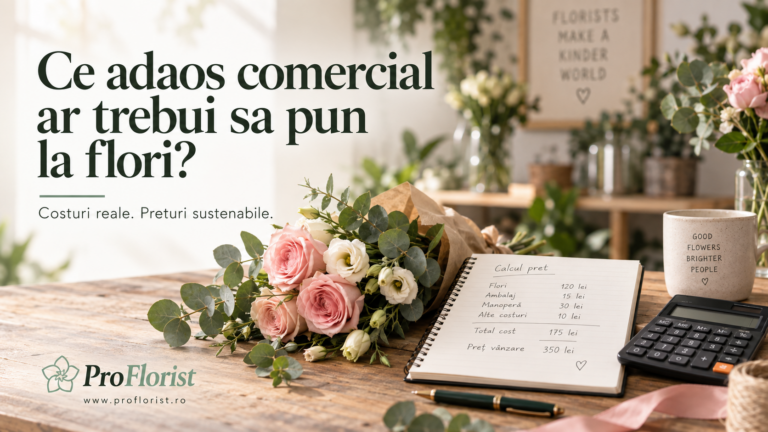
What commercial markup should I apply to flowers?
There is no universal commercial markup that is "correct" for all florists. A multiplier…
Business & Management / Software & Digitalisation
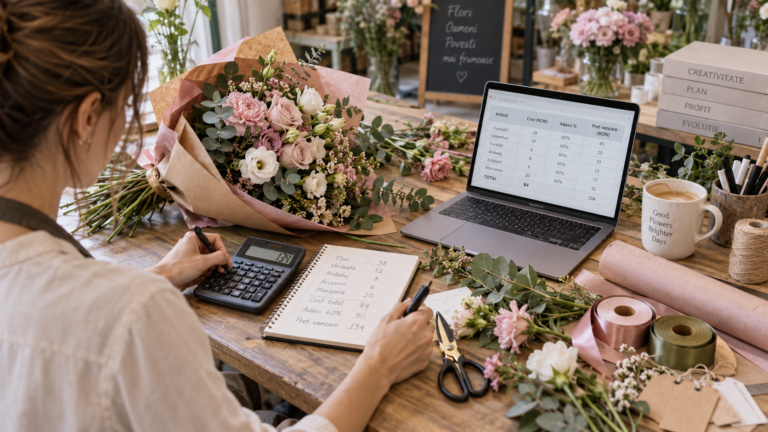
How to calculate the price of a flower bouquet correctly
A practical pricing method based on usable flower cost, greenery, consumables, direct labour, wastage…