Business & Management / Florists & Stories / Supply & Flower Industry
Dignity, professional standards and the future of Romanian floristry: a conversation with the AADF
This article opens a three-part series on Romania’s floristry industry. Drawing on an in-depth conversation with AADF representatives, it explores the realities, tensions and development priorities of a sector that needs recognition and professional structures as well as creativity.
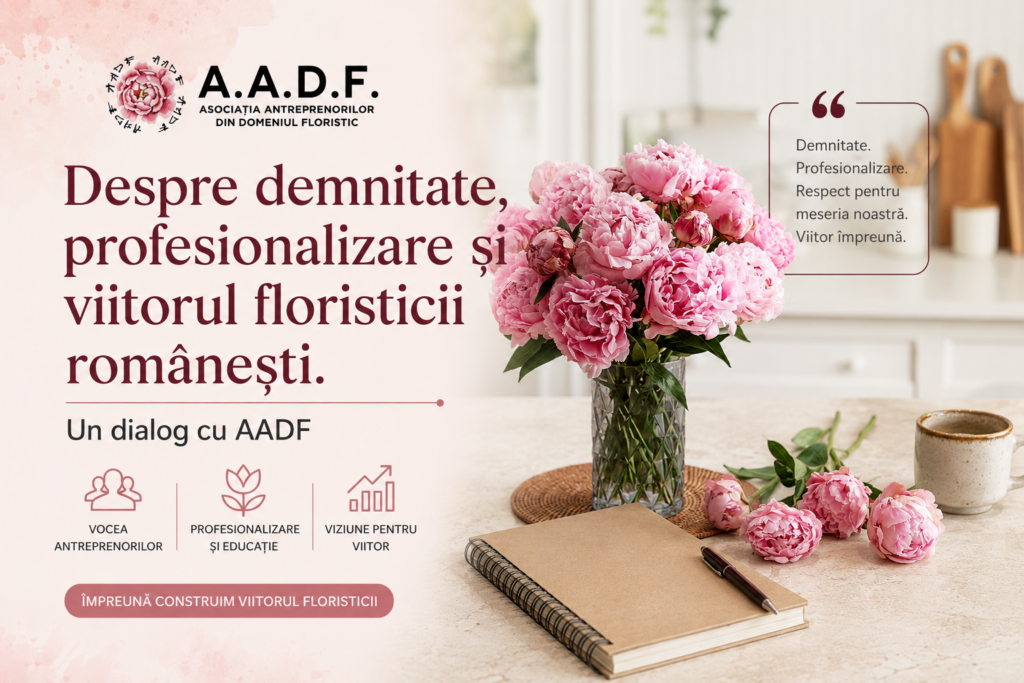
This article opens an editorial trilogy dedicated to the Romanian florist industry, built around a broad dialogue with AADF representatives. For three weeks (starting now), Every SundayWe will publish a new material about the realities, tensions and development directions of an industry that needs not only beauty, but also structure, education, courage and sincere conversations. & nbsp;
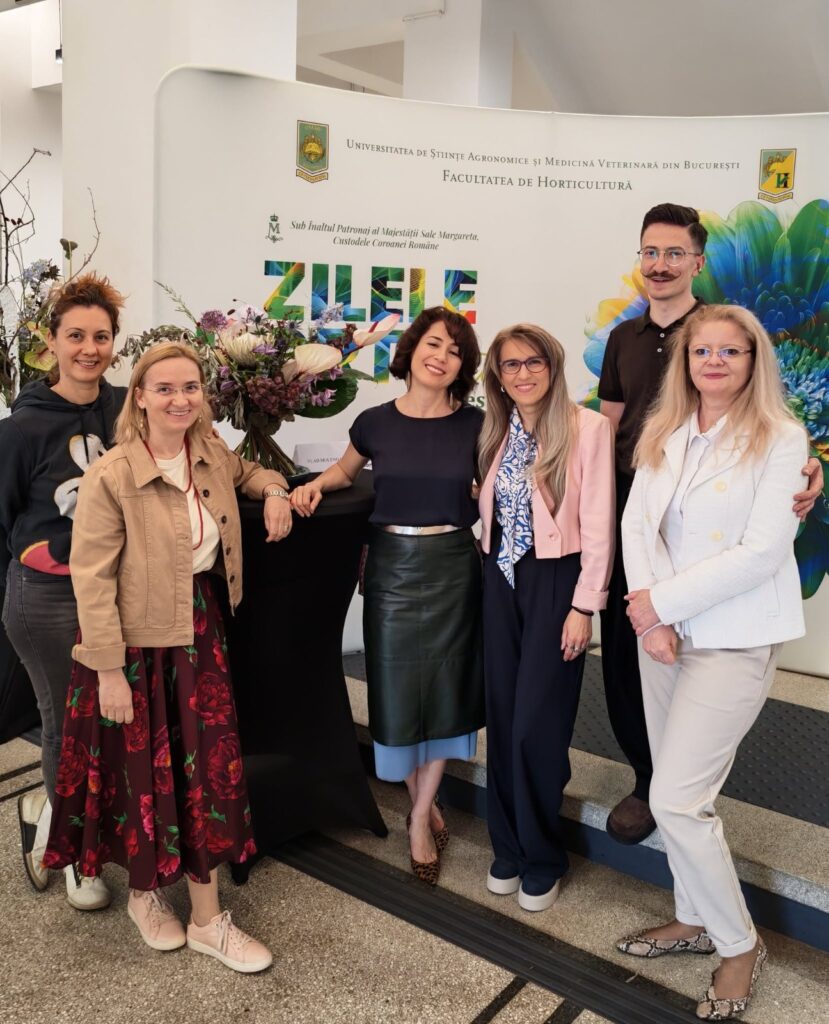
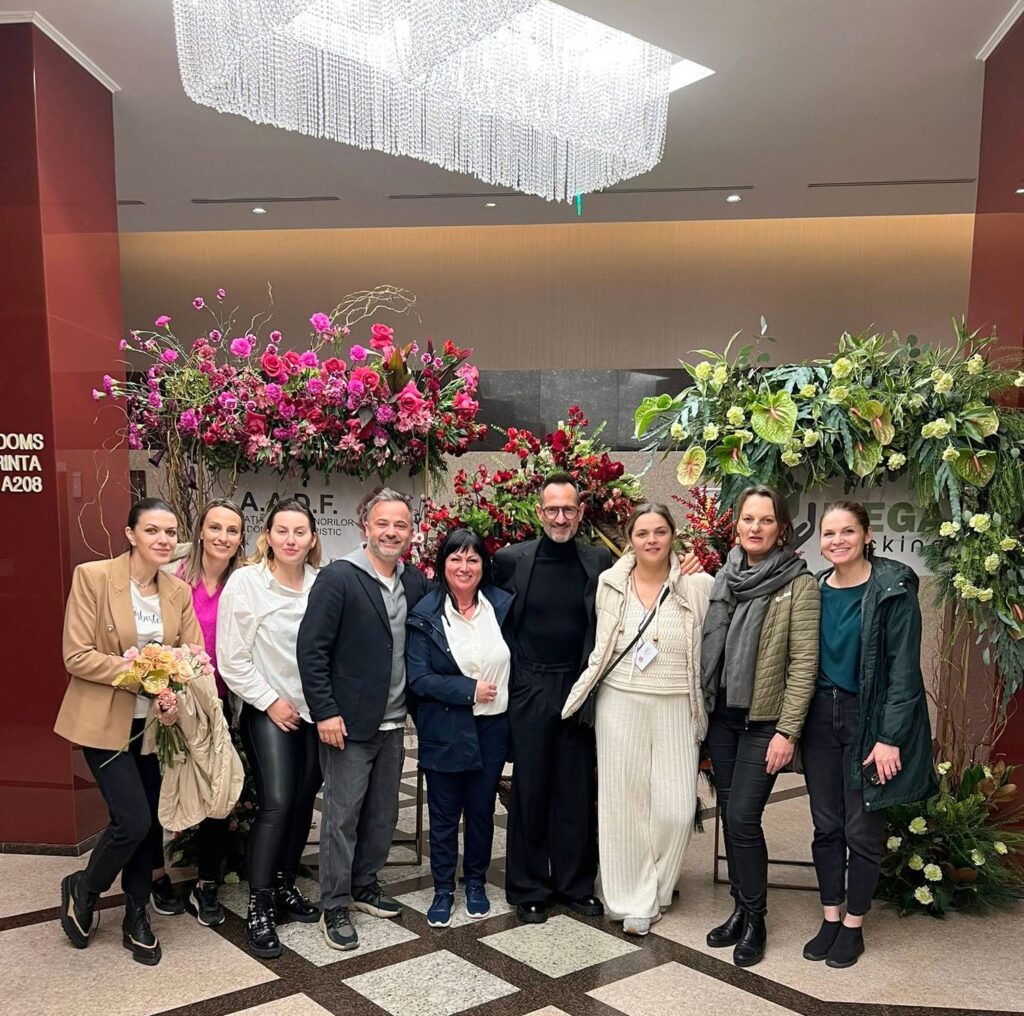
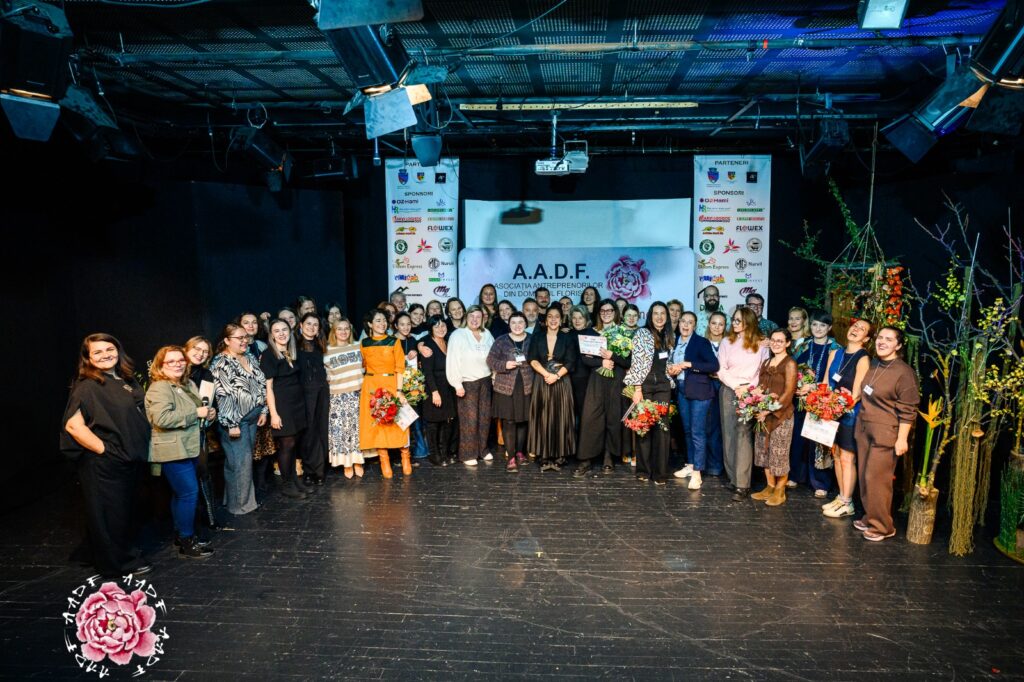
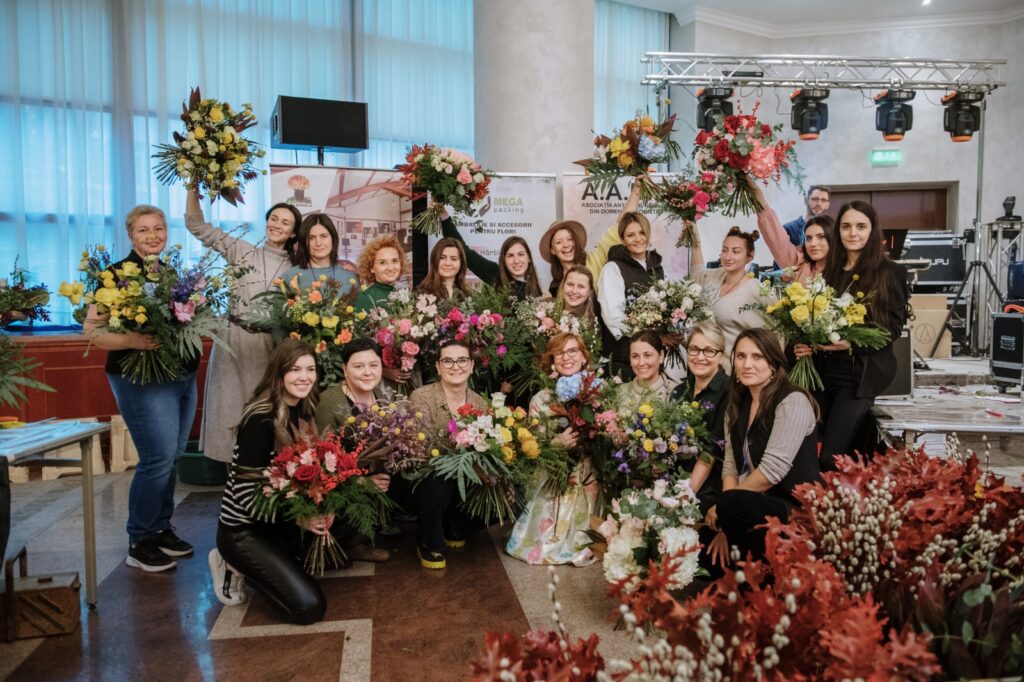
First contact with AADF It took place in the context of the flowersX event, held by Flowers Market Holland on 24 January. There I had the opportunity to personally meet some of the AADF community present at the event, including Cătălina Mincu and Magdalena Dumbravescu.
Later, I wanted to know the view of the association on several important topics for the Romanian florist industry: professionalism, education, business, competition, communication and the future of Romanian florist.
The answers below express the common voice of the AADF and the view of the association.
1. How has the flower industry in Romania changed in the last 10 years?
Question: If you were to describe Romanian floristry industry in three stages – 10 years ago, 5 years ago and today – what were the biggest changes you felt from within?
AADF: “On the anniversary of the 11 years of continuous, constant and consistent activity, the Romanian Association of Florestic Entrepreneurs looks with responsibility and lucidity at the transformations that have been shaping both the course of the fellow entrepreneurs and the evolution of the entire floristry sector.
We closely followed the dynamics of an area in a permanent process of redefining. From the perspective of the profession, a gradual professional evolution of the Romanian flower can be observed. Over the years, more and more sources of training and information have emerged, not always perfectly calibrated to the real needs of the profession, but overall, they have contributed to a certain degree of progress and to the strengthening of a florist culture.
Part of the floral products reflect a better understanding of the balance between artistic, technical expression and the value of the work undertaken. Of course, the process of maturing the field is still ongoing and the need for education and standardisation remains essential. However, every progress, however discreet, deserves recognition and support.
From an entrepreneurial perspective, however, we see a trend towards involuntary. The instability of the geopolitical context and the economic changes of recent years have also made their mark on the flowery domain, profoundly influencing consumer behaviour. Today’s customers are faster, more careful in decisions and more reserved in giving confidence. It is not a regression in the relationship between business and customer, but a new social reality that entrepreneurs have a responsibility to understand, assume and integrate wisely into their own work models. “
2. What marked the evolution of the market the most?
Question: What marked you most in the evolution of the market: the professionalism of florists, changing customer behaviour, price pressure, social media or the emergence of new business models?
AADF: “The flowering field in Romania continues to be one in a process of identity maturation and sedimentation, a still young professional space with reference to the solid tradition we encounter in many European states. We do not yet have, behind us, the institutional and cultural heritage of several decades or even centuries of existence that we find in the case of many Florint member organisations, the international reference structure of the florist industry, of which Romania is a member, as a full member and within which it today has an active and relevant presence at the Board of Directors.
In this context, the professionalism of the Romanian flower can be seen as a structural necessity. The genuine evolution of a guild cannot exist without coherent regulatory, validation and training mechanisms that provide consistency, predictability and social recognition. Currently, floristry remains within the profession level, not yet benefiting from the consolidated status and professional architecture specific to a mature profession.
Preparing for performance in the floristry sector involves a complex journey, built through complementarity between formal training, specialist education, continuous training, educational standards and informal training, acquired through practical experience, individual study, cultural exposure, international participation and permanent exercise of aesthetic sensitivity.
Moreover, the social status of a profession and its public legitimacy are inevitably built through the people who represent it. The credibility of a socio-professional category depends on the technical level of its practice, human quality, ethical conduct, responsibility and maturity of those who define its image in public space. “
3. Where does the balance between passion and profitability break?
Question: There’s a lot of talk about florist as art, but less about florist as business. Where do you think you most often break the balance between passion and profitability?
AADF: “There is more and more talk of florist in the art register. The term is easily used, but this apparent familiarity requires a fundamental distinction: what is, in essence, floral art and to what extent do we define today as” flower decoration “belongs to the sphere of art, floral design or simply commercial florist product?
This delimitation is deeply conceptual. Because the floristry sector exists in an area of interference between artistic sensitivity, aesthetic construction, functionality and economic mechanisms, which is necessary to coexist.
Between passion and profitability there is no doubt a large fracture, almost a tectonic relief of the contemporary profession. Passion occurs instinctively, viscerally, as a form of attraction to beauty, composition and expressiveness. But the path from creative sensitivity to profitable business requires the passage of an infinitely more complex territory, where talent alone becomes insufficient. That’s where the structure, discipline, economic education, strategic intelligence and the ability to understand human behaviour come in.
Floral art can be defined as a manifestation of inner expression, while floral design builds on clear principles of composition, proportion, rhythm, colour and function.
Maybe that’s exactly why art poses questions, while design provides answers. Between the two there is an extremely subtle border area, which many florists try to live simultaneously, sometimes without realising the fundamental differences between them.
Beyond this border, however, is the business, the most pragmatic and perhaps least understood size of the florist industry. The business is a territory governed by firm economic rules, financial sustainability, operational management, taxation, market positioning and strategic construction, it is an area where emotion must be converted into economic value without compromising its authenticity.
And perhaps the true difficulty of contemporary flower is to maintain a balance between the freedom of artistic sensitivity and the rigors of an economic reality that operates on the basis of consistency, structure and capacity for continuous adaptation. “
4. What discussions remain behind the scenes?
Question: What are the important discussions that the florists have “behind the scenes,” but that almost never reach the final customer?
AADF: “Such uncomfortable conversations inevitably exist within any domain. Each profession builds, over time, its own space of silent difficulties, unspoken fatigue and invisible compromises. They are organic realities of any activity carried out under the pressure of performance, human relationship and continued responsibility.
But the real measure of professional maturity is how we choose to manage them and the discernment with which we decide what belongs to the internal space of the profession and what can be legitimately transferred to public space.
When professional frustration becomes a recurring public discourse, it often loses its value and risks turning into a form of emotional exposure aimed at external validation and collective attention.
There is an extremely fine line between authenticity and the show of vulnerability, and contemporary society often confuses these two registers. Of course, vulnerability can humanize professional discourse and create emotion. However, apart from the context of clarity and responsibility, it can easily become a form of dilution of professional authority. Sometimes discretion is the expression of a sophisticated professional intelligence.
In particular, public exposure of customers perceived as difficult can erode one of the most fragile and valuable values of any service-based domain: trust.
The florist has no vocation to publicly discipline the client and no responsibility to reshape his behaviour through moralizing speech. Its role is much more subtle and sophisticated: to guide with elegance, to facilitate conscious choices and to build coherent experiences for those people who want dialogue, understanding and genuine value.
And where value compatibility does not exist, maybe one of the most mature professional tools: the ability to say no. A calmly, clearly and elegantly formulated refusal protects incomparably both the dignity of the entrepreneur and the balance of the professional relationship, rather than an agreement obtained by emotional compromise and subsequently consumed in “behind-the-scenes” resentment speeches. “
5. What are industry’s biggest vulnerabilities?
Question: What are the biggest concerns of florists and flower shops at the moment: costs, lack of qualified staff, seasonal, imports, unfair competition, customer education or digitisation?
AADF: “Returning to the geopolitical and economic context that Romania is going through during this period, we believe that some of the most sensitive vulnerabilities of the floristry sector come from two structural imbalances that profoundly affect the sustainability of the domain: staff shortages and unfair competition.
The lack of qualified staff has become almost an “outdated” phase of the problem. We are discussing the absence of the human resource itself, regardless of the level of preparation. In the current socio-economic context, the mere possibility of building and maintaining a functional team is becoming a major challenge.
At the same time, there is also the well-known reality of informal vocational training within florist businesses: the period during which an employee learns, accumulates experience and develops his skills to then open his own business and become a competitor. It is an old phenomenon, impossible to see exclusively in absolute terms of good or evil. Finally, it is the market, professional maturity and ability of each business to generate genuine value that decides long-term sustainability.
However, the issue of unfair competition, increasingly felt by entrepreneurs operating in a structured, tax and professional way, whether we are talking about florists, floral workshops or companies specialised in organising events, remains equally important.
Practices by which some importers, flower wholesalers and plants or even part of Romanian flower producers choose to market directly to the final consumer they have gradually become a normal market. Naturally, this overlap of commercial roles causes imbalances and weakens the economic ecosystem of the flower sector, particularly affecting the business segment that constantly invests in services, experience, staff, logistics and the direct relationship with the final customer.
Perhaps a more mature and profitable development for the entire ecosystem would require the import, wholesale distribution or Romanian production area to focus its resources on developing efficient marketing and loyalty strategies dedicated to business customers, legal entities, florists and floral workshops, while the relationship with the final consumer remains in the natural area of the flower, where the floral product becomes meaningful through advice, personalisation, emotion and professional experience.
Because, essentially, a healthy floristry sector is built through balance between all the links that make it up, through mutual respect between the actors of the domain and through their ability to understand their role in the architecture of a sustainable market. “
6. What does a healthy floristry business look like today?
Question: From the perspective of AADF, what does a healthy florist in business mean today? Is it enough to have floral talent or do you need processes, figures, stocks, marketing and technology?
AADF: “There are florists endowed with remarkable creative sensitivity, aesthetic instinct and artistic intelligence, but without the inner availability required to assume entrepreneurial pressure. As there are people for whom business represents an almost organic ability, a distinct form of talent, built from strategic vision, economic lucidity and the ability to transform the emotional fragility of an artistic product into a functional and sustainable mechanism.
Having “employee talent” can, in many contexts, be a rare form of balance, discipline and relational intelligence.
If we are talking about the idea of a “perfectly healthy” business in Romania, perhaps the wording itself requires some degree of idealization. The Romanian floristry sector continues to operate in a climate of structural instability, in a permanent exercise of adaptation to economic, fiscal, social and cultural realities in an accelerated transformation.
In this context, a business resilience can be defined as a continuous capacity for recalibration. A functional business becomes, today, one that manages to remain flexible in relation to its vulnerabilities.
The challenges in the anatomy of a business refine and take on other forms. That is why perhaps the term “healthy” applied to entrepreneurship remains a relative one. Because stability is a continuous form of maintaining balance.
Perhaps one of the most honest metaphors for entrepreneurship is this: even when your doctor confirms that you are healthy, you continue to take calcium and magnesium preventatively. Not from anxiety, but from a clear understanding that balance is not preserved through certainty, but through constant attention, prevention and the ability to anticipate fragilities before they become visible. “
7. Where are the greatest skills gaps?
Question: AADF places emphasis on education and professionalism. Where do you think there is the greatest lack of skills in the market: floral technique, sale, pricing, management, customer communication or operational organisation?
AADF: “All the above dimensions converge, in substance, to the same essential axis: education and professionalism of the floristry sector. Not by chance, the Association of Romanian Floristical Entrepreneurs has consistently chosen to place these two directions at the heart of his speech and institutional endeavours.
Beyond aesthetic trends, commercial dynamics or consumer transformations, the flowering field can strengthen its professional identity through the culture of competence, rivalry and responsibility assumed. It builds slowly, through coherent education, valid training mechanisms, institutional continuity and the sedimentation of professional standards capable of generating not only technical performance but also social credibility and professional maturity.
In reality, all these components, formal education, continuous training, skills standardisation, definition of professional ethics, trade delimitations, institutional representation, the relationship between actors in the floristry sector and the social recognition of the profession, work interdependent and together form complex architecture of the process of professionalism.
An area that invests consistently in education, standardisation, professional responsibility and institutional representation can build, over time, not only economic stability, but also professional authority, genuine cultural relevance and continuity for generations that will define the future of Romanian florists. “
A dialogue about flowers, but especially about people
At the end of the conversation, the feeling remains that Romanian florist lies at a crossroads. Not because he lacks beauty. Beauty exists. Not because he lacks talent. Talent exists to the full. But because there is a need for solid bridges between talent and industry: education, standards, ethics, economics, collaboration and representation.
And perhaps here lies the true force of AADF: not only in the fact that it represents a guild, but in the way that it tries to give this guild a mature voice.
This is the first article in the trilogy dedicated to the florist industry in Romania. In the next three weeks, we will publish a new article every Saturday, precisely for the florists, entrepreneurs and people in the industry to have time to quietly read over the weekend, reflect, interact and give us their sincere views.
We think it’s time to start a real conversation. Let us not only talk about beautiful flowers, but also about what it means to build, resist, educate, sell properly, work with dignity and find your place in a constantly changing market.
Maybe it’s time to open Pandora’s box. With responsibility, but without fear. Respectfully, but without detour. Because beyond bouquets, sets, events and trends, the flower industry needs people who not only love beauty, but know how to defend it. With structure. With education. Respectfully. With dignity.
Related articles
More ideas from the same area

Business & Management / Florists & Stories
How to calculate the real margin on a flower bouquet
A practical method for calculating contribution margin from net revenue and the variable costs…

Business & Management / Florists & Stories
What commercial markup should I apply to flowers?
There is no universal commercial markup that is "correct" for all florists. A multiplier…
Business & Management / Florists & Stories
Oana Dumitrache of Florăria Adelle Călărași on vocation, competition and a florist’s legacy
An interview with Oana Dumitrache of Florăria Adelle in Călărași about creative practice, business,…