How flower shops can use AI for personalised floral design
Artificial intelligence is starting to change the way customers discover, choose and buy products, and florists are not outside of this transformation. In retail, AI is already being used for personalisation, product recommendations, inventory optimisation, more relevant shopping experiences and customer-tailored communication. Google Cloud describes the uses of AI in retail as including personalisation [...]
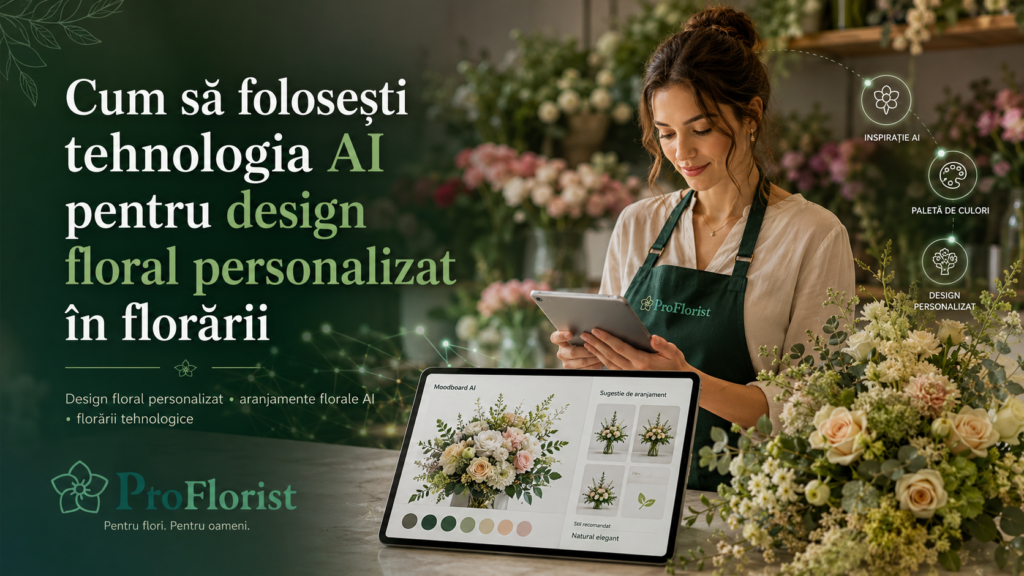
Artificial intelligence is starting to change the way customers discover, choose and buy products, and florists are not outside of this transformation. In retail, AI is already being used for personalisation, product recommendations, inventory optimisation, more relevant shopping experiences and customer-tailored communication. Google Cloud describes the uses of AI in retail as including personalisation of the shopping experience, more efficient operations and better inventory management, and McKinsey points out that AI and generative AI can help companies scale personalised interactions with consumers. For florists, this direction doesn’t mean that the machine will replace the florist, but that the florist can finally have a digital assistant that helps them create faster, communicate more clearly, and turn the customer’s vague wishes into better-suited floral arrangements.
In floristry, customization has always existed. A customer walks into the florist and says: “I want something delicate but not mundane”, “I want a bouquet that looks expensive but not heavy”, “she likes pink flowers but not too sweet”, “I want something for a woman who is elegant but warm”. The florist translates these phrases into a composition: choose the colour palette, texture, proportion, dominant flowers, greenery, packaging, overall style. The difference is that, until now, this translation depended solely on the florist’s experience and available time. In a busy day with phone calls, orders, deliveries, WhatsApp messages and stock pressure, deep customization was becoming difficult for every customer. This is exactly where AI can step in: not as the ultimate designer, but as a tool to clarify, inspire, structure and sell smarter.
Why AI is relevant to custom floral design
One of the great advantages of artificial intelligence is the ability to turn disparate data and preferences into coherent suggestions. In a florist, this data can be simple: the occasion, the approximate age of the recipient, the relationship between the client and the recipient, the budget, favourite flowers, avoided colours, desired style, delivery date and possibly a personal message. From this information, an AI system can propose a design direction: romantic, minimalist, garden style, premium, cheerful, sober, corporate, natural, spectacular or discreet.
Florists’ Review, in a feature on the use of AI in the floral industry, mentions applications such as predicting demand, tracking buying patterns, adjusting inventory and avoiding oversupply. Although these examples are closer to flower shop management than actual design, they show something essential: AI becomes valuable when it connects creativity with real business data. A custom floral design isn’t just a pretty idea; he must also take into account what flowers are available, what is selling in season, what budgets the customers have and what products can be made profitably.
For example, if a florist notices that in May customers order a lot of pastel bouquets for birthdays, AI can help create personalised proposals around this trend: bouquets with peonies, garden roses, lisianthus, mathiola and fine greenery, in palettes of powder pink, cream, lilac or peach. If, at the same time, the available stock includes more coral flowers than pale pink, the AI can suggest a similar variant, but adapted to the reality of the flower shop. This is where the real utility comes in: customization, but no waste; creativity, but with operational logic.
AI does not replace the florist. It organizes his thinking
One of the common fears is that technology will standardise floristry. If all florists use AI, will they all end up making the same bouquets? The answer depends on how the technology is used. If AI is used superficially, only for spectacular artificially generated images, there is a risk of creating unrealistic expectations and products that are difficult to reproduce. But if used as a working tool, AI can become a very useful partner for the florist.
FlowerBuddy, in an article on AI for florists, discusses the idea of using AI without losing the authentic voice of the brand and proposes different levels of use, from quick brainstorming to repetitive processes integrated into work tools. This idea is very important for florists: AI should not create an artificial identity, but help the florist better express its own style.
A good florist already knows what harmony, proportion and emotion mean. The AI can help him formulate three proposals for the client more quickly, create a clear description for each, recommend options according to the budget or generate an indicative moodboard. But the final decision remains with the florist. He knows if the available roses are open enough, if the hydrangea holds up well in that composition, if the season allows for certain combinations, and if the bouquet will look good in reality, not just in a digital image.
Let’s take a concrete example. A client wants a bouquet for his wife’s birthday, says he likes warm colours, doesn’t want something “too classic” and that the customer has a defined budget. A well-configured AI system for a flower shop can turn this information into a design proposal: coral roses, cream lisianthus, pale orange ranunculus, eucalyptus accents and nude packaging, in a romantic-modern style. It can also suggest a sales description: “a bright, warm and elegant bouquet, suitable for an anniversary where you want to convey admiration, not just tick off a gift”. The florist then decides if the recipe is realistic, if the flowers are in stock and if the proportions are correct.
Personalisation starts with better questions
In many florists, personalisation starts and ends with the question “what flowers do you want?”. But customers don’t always know what flowers they want. They know what they want to convey. This is precisely why AI can be used to build a smarter consulting process. Instead of just asking about flowers, you can ask about person, occasion, style and emotion.
A digital form or an AI-powered ordering interface can ask: who is the bouquet for, what is your relationship with the person, what do you want them to feel when they receive the flowers, do you prefer something romantic, elegant, cheerful, minimalist or spectacular, are there colours to avoid, are there favourite flowers, what is the budget. From these answers, the florist can create much better recommendations than a simple list of products.
This is where ProFlorist can play an important role for local florists. A platform built for florists shouldn’t just be a digital catalogue, but a system that helps the florist sell better. If you have organised products, clear images, customization options and a smart ordering flow, the customer is guided to a more suitable choice. Instead of randomly choosing the cheapest bouquet, he can be guided to an arrangement that better suits his occasion and budget.
In modern retail, customization is no longer a luxury. McKinsey notes that as more consumers seek tailored online interactions, companies can use AI and generative AI to personalise experiences on a larger scale. In floristry, this can mean bouquet recommendations depending on the occasion, personalised text for cards, upgrade suggestions, gift packages or seasonal variations tailored to the customer’s style.
From visual inspiration to real floral arrangements
Another way AI can help florists is generating visual directions. A customer can submit a photo of a dress, event decor, festive table, wedding invitation, or even a picture from Pinterest. The AI can analyse the visual style and suggest a floral palette: ivory, blush, sage green, caramel, burgundy, coral, lavender or champagne. It can identify whether the image conveys a modern, rustic, boho, elegant, dramatic or natural style.
However, it must be made very clear here: AI images should not be used as an accurate promise if the florist cannot reproduce them. In floristry, reality matters enormously. Flowers are alive, have different shapes, different degrees of openness, seasonality, availability and resistance. An artificially generated image may be beautiful, but it may include flowers that are impossible to combine, unrealistic sizes, or colours that do not exist in nature in that form. That’s why AI should be used for inspiration, not to create false expectations.
A professional process might look like this: the customer sends a visual reference, the AI proposes three design directions, the florist adjusts each proposal based on stock and experience, then the customer receives a realistic recommendation. Not “we make you exactly as in the picture”, but “we can create a variation inspired by this atmosphere, using available flowers suitable for the season”.
AI design tools are evolving rapidly. Canva, for example, offers AI tools for product images, including the ability to upload an image and generate product photos based on a prompt. For florists, such tools can help to present products more attractively, create clean backgrounds or visuals for campaigns, but they must be used carefully so that the final product is not distorted from what the customer receives.
AI for events: weddings, baptisms, corporate and theme arrangements
Custom floral design is becoming even more important in the event area. There, the customer doesn’t just buy a bouquet, but an atmosphere. For a wedding, for example, the flowers must match the location, the dress, the colour of the invitations, the season, the lighting of the space, the style of the bride and groom and the budget. AI can help florists create coherent concepts faster and communicate more clearly with the customer.
A couple may say they want a “warm, romantic but not classic” wedding in an elegant barn in early September. The AI can suggest a palette of cream, terracotta, peach, olive green, and burgundy accents, then suggest flower types: dahlias, garden roses, lisianthus, scabiosa, amaranthus, eucalyptus, and subtle dry textures. The florist can adapt the proposal according to availability and budget. Instead of starting from scratch, start from a smart draft.
For corporate events, AI can be used differently. It can interpret brand colours, event type and company message, then suggest arrangements that convey professionalism, freshness, understated luxury or creative energy. If a company has a launch event for an eco product, the AI can suggest a design with green plants, white flowers, natural elements and reusable containers. If it is a premium gala, it can propose more sculptural compositions, with elegant flowers and sophisticated colours.
An article on floral trends for 2025 mentions growing interest in virtual floral consultations and augmented reality tools that can help customers visualize arrangements in real spaces before purchase. Even if not all local florists will immediately implement AR, the direction is clear: the customer wants to see, understand and feel the product before paying. AI can be the bridge between imagination and decision.
AI and profitability: personalisation without operational chaos
Personalisation can be profitable, but it can also become time-consuming. If each customer asks for something unique, and the florist manually responds to each message, searches for pictures, makes proposals, changes variants and recalculates prices, customization becomes tedious. AI can help intelligently standardise the process without destroying the feel of the unique product.
For example, the flower shop can have several customizable design directions: romantic pastel, elegant premium, natural garden, vibrant colorful, minimalist white-green, dramatic burgundy. The AI can recommend one of these directions based on the customer’s responses, then adjust the text, flowers, and budget. Thus, the customer feels that he is receiving a personal recommendation, and the florist does not start from scratch every time.
This is an essential difference. AI should not be used to chaotically invent a completely different bouquet for each customer. It would be difficult to manage and risky for the margin. It is smarter to use AI to guide the customer to profitable product ranges, already thought of by the florist, but presented in a personalised way.
Suppose you have three options for an anniversary bouquet: an entry-level, a mid-range and a premium budget. The AI can explain the difference between them in an emotional and commercial way: the entry-level option is delicate and suitable for an elegant gesture; the mid-range option has more volume and visual impact; the premium option is a memorable surprise, suitable for moments when you really want to impress. The customer is no longer just comparing prices, but understanding levels of experience.
AI for texts, descriptions and greeting messages
One area where AI can immediately help any florist is communication. Many florists create beautiful bouquets, but describe them dryly: “bouquet of pink roses and eustoma”. The same composition can be sold much better if the description conveys emotion, context and value: “a bright and delicate bouquet, created for moments when you want to convey affection, elegance and care without using too many words”.
AI can help florists write product descriptions, campaign texts, Instagram captions, question answers, upsell messages, and greeting card variations. It is important that the florist does not mechanically copy everything that the AI produces, but edits the text in such a way as to preserve the voice of the brand. An elegant florist will speak differently than a playful florist, and a premium florist will have a different tone than a very popular and affordable one.
For personalised floral design, AI can generate messages based on the occasion. If a customer buys a reconciliation bouquet, the message should be gentle. If it’s for a birthday, it can be warm and bright. If it is for professional success, it can be elegant and respectful. These details increase the perceived value of the order. The customer feels that the florist helps him not only with flowers, but with the whole gesture.
The ethics of using AI in floristry
Any florist using AI must maintain honesty with the customer. If an image is artificially generated and does not accurately represent the final product, this should be handled carefully. Ideally, the main product images should be real, taken in the flower shop or on deliveries. AI can be used for moodboards, concepts, backgrounds, inspiration and visual campaigns, but it shouldn’t create a big gap between promise and reality.
In floristry, trust is very important. The customer does not always see the product before it is delivered. He orders based on the florist’s photo, description and reputation. If the AI creates perfect, impossible-to-reproduce bouquets, the customer may be disappointed when they receive a real version, even if it is beautiful. That’s why the rule should be simple: the AI inspires, the florist validates, the real product confirms.
There is also an ethical dimension: the AI must support the florist, not erase his style. A local florist has personality, experience and a real relationship with the community. Technology must amplify this identity, not turn it into generic content. This is precisely where the difference between a tool and a platform designed for florists comes into play: a good system must take into account the reality of floral work, not just the general logic of online commerce.
What an AI-ready flower shop could look like
An AI-ready florist is not necessarily a futuristic one with screens everywhere and robots tying bouquets. It is, rather, an organised flower shop. It has clear products, good photos, well-defined categories, tracked stock, recognisable floral styles, calculated pricing and digital processes that don’t just depend on lost WhatsApp messages.
In such a flower shop, the AI can work with real information. If he knows what products you have, what flowers are available, what sells well, what margins you have and what style your customers prefer, recommendations become much more valuable. If the data is chaotic, the AI will also produce chaotic suggestions. In other words, AI doesn’t fix disorganization, it makes it more visible. But in a well-structured flower shop, it can become a real accelerator.
ProFlorist can become such an infrastructure for local florists: a place where orders, products, visibility and daily management are better connected. When the florist has the digital side in order, it can more easily use AI for recommendations, texts, personalisation, campaigns and business decisions. And this matters for the future, because the florists who will win will not only be the most talented, but those who will know how to combine creativity with organisation and technology.
Conclusion: AI does not make floristry cooler, if used correctly
Floristry is and will remain a job of emotion, good hands, taste, proportion and sensitivity. Artificial intelligence cannot smell a freesia, feel the fragility of an over-open ranunculus, and cannot replace a florist’s instinct that knows when a bouquet is “alive.” But it can help enormously around this process: it can clarify the customer’s wishes, suggest directions, write better descriptions, reduce wasted time, support the sale, and make customization a more manageable process.
For local florists, floral design AI technology doesn’t mean giving up the art. It means protecting your time, better leveraging your creativity, and giving your customer a clearer, more personal, and more compelling experience. The personalised floral design thus becomes more accessible, better presented and more profitable.
Technological florists won’t be the coolest looking or the most automated. They will be the florists who use technology discreetly, intelligently and humanely. Those who know how to turn a vague desire into a memorable bouquet, a simple order into a personal experience and a complicated process into a more beautiful, clearer and better organised sale. ProFlorist starts from exactly this: from the belief that local florists deserve modern tools, but built for the real way florists work.
Related articles
More ideas from the same area
Business & Management / Events & Community / Florists & Stories / Marketing & Sales / Supply & Flower Industry
ProFlorist’s Bucharest florist meeting on 3 July 2026: event archive
Archive note: this meeting took place in Bucharest on 3 July 2026. The article…
Online flower shop homepage: how to sell more online
The homepage of an online florist is the digital storefront that decides in seconds…
Business & Management / Florists & Stories / Marketing & Sales
Today’s flower shop is also about business decisions: an interview with John Buskermolen
John Buskermolen of Waterdrinker discusses supply, differentiation, costs and structured growth. His answers are…