Understanding the floriculture market: forecasts and business themes for 2026–2033
Published floriculture forecasts differ substantially because they use different definitions, markets and methods. This guide uses one named 2026–2033 forecast as a reference point, distinguishes projections from facts, and reviews the technology, supply-chain, sustainability and customer themes that flower businesses may wish to examine.
Global floriculture is evolving. Alongside flowers, bouquets and events, businesses face changing technology, environmental impact, supply chains and customer behaviour.
This article examines a published 2026–2033 outlook for flower shops, distributors and platforms such as ProFlorist. Forecasts are not guarantees, and market values vary between researchers.
Market size and the limits of global forecasts
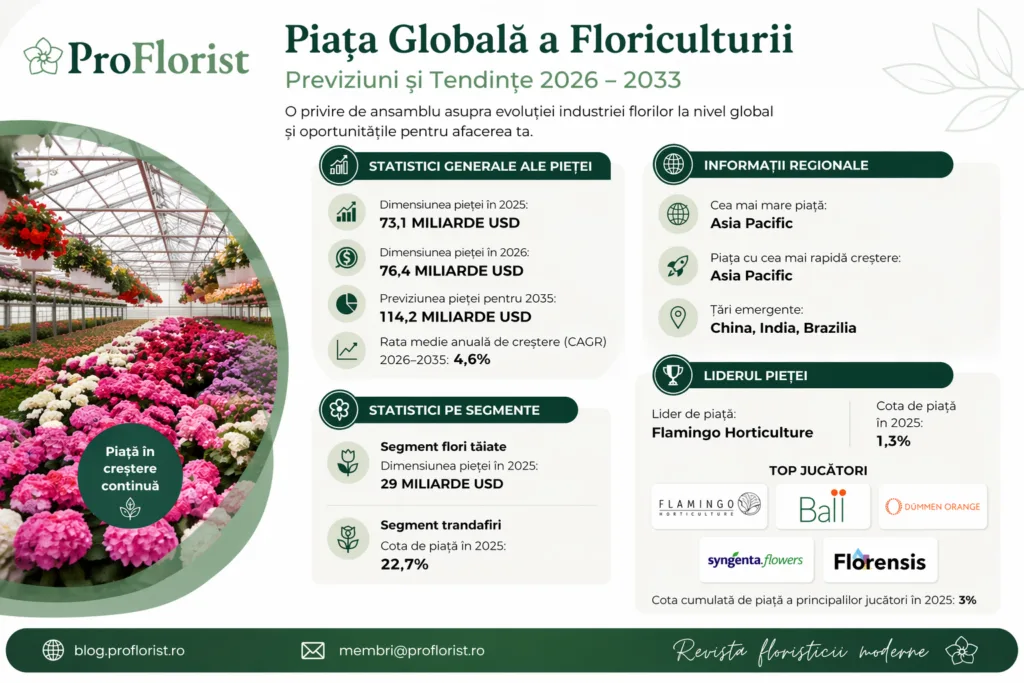
Persistence Market Research estimated floriculture at US$65.9 billion in 2026 and projected US$104.5 billion by 2033, a 6.8% annual growth rate. These figures replace unsupported Romanian-draft values and should not be combined with differently defined estimates.
What does that mean in practice?
- The report anticipates growth, but demand can vary by product, country and year
- Competition and operating conditions may change as channels evolve
- Forecast growth may create opportunities, but it does not remove commercial risk
Themes that may influence floriculture
Floriculture reflects retail, horticulture, logistics and consumer behaviour. These are themes to investigate, not universal outcomes.
Commonly cited themes include:
✔ Digital sales and operations
Online shops, marketplaces and operational software can change how orders are marketed, accepted and fulfilled.
✔ Automation and production technology
Controlled environments, sensors, irrigation and selected AI tools may improve processes when investment and data are suitable.
✔ Environmental performance
Some buyers consider origin, resources, packaging and production. Environmental claims should be specific and supportable.
✔ Public policy and funding
Support differs by country and programme; businesses should verify eligibility rather than assume funding.
✔ International partnerships
Collaboration among breeders, growers, distributors and technology providers may support products or processes, subject to contracts.
Industry challenges in 2026
Even forecasts that predict growth identify operational risks and constraints.
Issues worth testing in a business plan include:
- Production and transport costs
- Upfront investment in technology or logistics
- Supply-chain disruption
- Availability of suitably skilled people
- Differing rules and standards between countries
For small and medium-sized flower businesses, the impact depends on their market, margins, suppliers and operating model.
What forecasts suggest may change by 2033
Outlooks suggest possible growth, but totals and assumptions differ. Technology and buying habits are themes, not certain results.
Themes to monitor:
AI and automation
Applications span cultivation, forecasting, customer service and orders; value depends on implementation.
Resource-aware production
Water, energy and crop-protection inputs can be measured and reduced where agronomy, quality and local conditions allow.
Data-informed management
Data can support decisions but not replace judgement, context or quality checks.
Strategic collaboration
Partnerships can connect brands, growers, distributors and platforms when roles and value are clear.
Product and service diversification
Businesses may combine flowers with subscriptions, services or experiences, but each offer still requires demand, capacity and viable pricing.
How floriculture markets are commonly segmented
Reports segment the industry differently. These categories are a practical overview, not a universal standard.
1. By product type:
- Cut flowers (including roses, tulips and lilies)
- Potted plants
- Ornamental and garden plants
Cut flowers feature in gifts and events; their share depends on definition and region.
2. By use:
- Gifting
- Residential and commercial decoration
- Industrial uses, including fragrances and essential oils
- Landscaping
Gifting is an important demand occasion, but its market share varies by dataset and country.
3. By distribution channel:
- Independent flower shops
- Supermarkets
- E-commerce and marketplaces
- Auctions and wholesale trading systems, including those in the Netherlands
- Garden centres
Online channels are closely watched in market reports, but the source draft does not establish a comparable global “fastest-growing” rate.
Regional differences
Floriculture varies regionally, while broad labels can hide differences between countries.
Regions frequently covered in forecasts include:
North America
- established retail and production markets
- varied adoption of digital and production technology
Europe
- strong trade and production networks in several countries
- the Netherlands as a major auction and logistics hub
Asia–Pacific
- expanding urban consumer markets in parts of the region
- significant differences in production, income and distribution
Latin America and the Middle East
- important production, export or consumption opportunities in particular countries rather than one uniform regional market
What this may mean for local flower businesses
Flower shops, distributors and providers such as ProFlorist should test strategy against local data, not one global headline.
Five practical areas to examine:
- Appropriate digital tools
→ use online and operational systems where they solve a defined customer or workflow problem - Experience alongside the product
→ explain the design, service and occasion without making unsupported emotional promises - Logistics
→ measure lead times, capacity, waste and delivery reliability instead of assuming speed alone wins - Brand and differentiation
→ make the proposition clear and consistent with the product actually delivered - Environmental claims
→ measure specific practices and evidence claims before using them as purchase messages
Global floriculture is changing, but no single forecast describes every flower business.
Broader services or experiences may suit some businesses if they are authentic, deliverable and commercially viable.
Businesses should test technology, brand and operations against customer and financial evidence; no evidence here shows one approach will dominate.
If you work in floristry or the wider industry: Which part of this change is most relevant to your market and customers?
Related articles
More ideas from the same area

Business & Management / Florists & Stories
How to calculate the real margin on a flower bouquet
A practical method for calculating contribution margin from net revenue and the variable costs…

Business & Management / Florists & Stories
What commercial markup should I apply to flowers?
There is no universal commercial markup that is "correct" for all florists. A multiplier…

Business & Management / Software & Digitalisation
What do you check for a flower shop program if you work from your phone and computer
What you check in a flower shop program on phone and computer: orders, roles,…