Business & Management / Supply & Flower Industry
Flower producers in Romania: a lesson from Australia that should make us think
This article examines reports about Romanian flower production and imports, using an Australian case study as editorial context. Market shares, production volumes and working conditions can change and should be checked against current primary sources before being quoted.
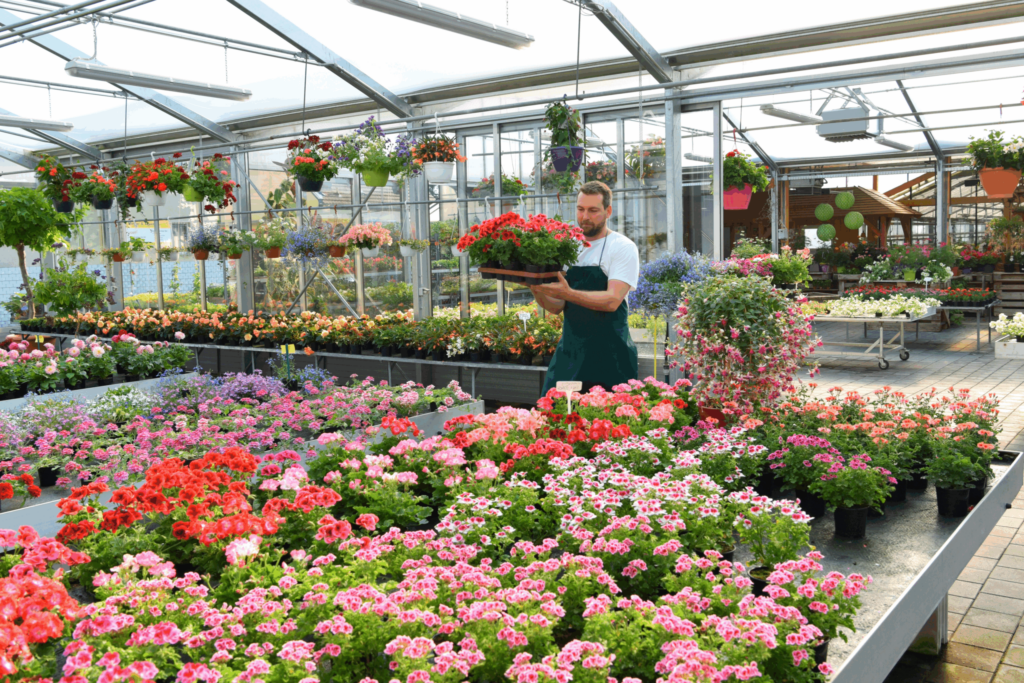
In Tasmania, a spectacular region of Australia, a family of flower producers is fighting for an important change: the introduction of mandatory labeling of the origin of imported flowers.
Reason? About half of the flowers sold in Australia come from other countries – a reality that, local farmers say, seriously affects domestic production and leaves consumers without essential information about what they are buying. Pip Sadler and her brother, Rob, run a modern flower shop with high-tech greenhouses in northwest Tasmania, in the town of Flowerdale.
“If every food item has to say where it was produced, the same should apply to flowers,” says Pip.
She raises an issue that many Romanian florists also feel: consumers know nothing about imported flowers – how they were grown, by whom, under what working conditions, and with what chemical treatments.
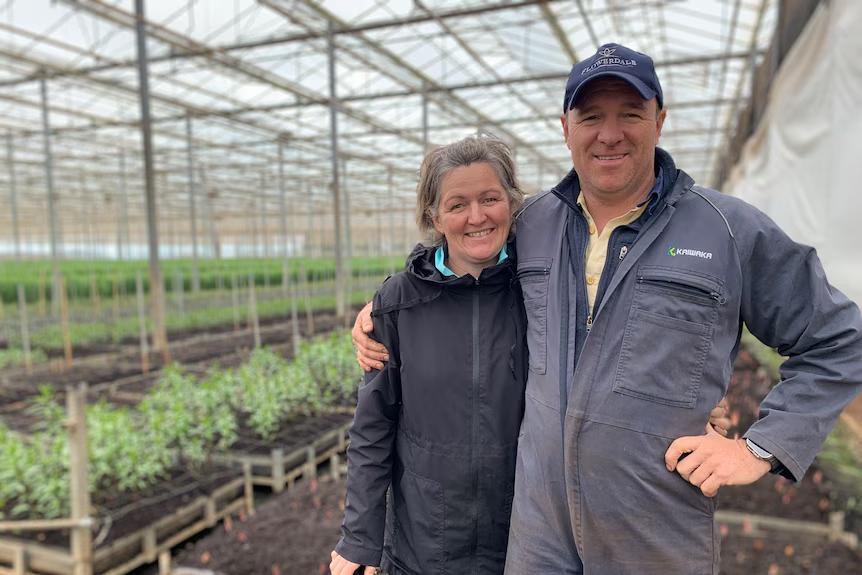
“We don’t know who picked them, how much that person was paid, and how many thousands of kilometers the flowers flew to reach us,” says Pip.
The Sadler family wants to teach people to think differently when buying flowers: to ask themselves who grew them and what impact each purchase has on the environment, local economy, and ethical standards in the industry.
Their sister, Bec Thomas, gave up a corporate career in Brisbane to open a flower shop where she sells exclusively local flowers.
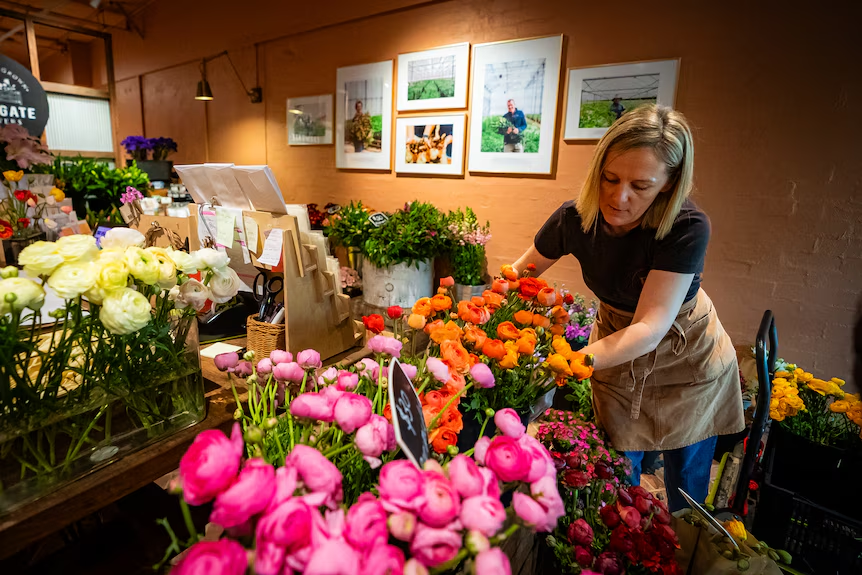
“I wanted people to know their farmer. To know that those flowers were grown by Rob and Pip, harvested, cooled, packaged and shipped overnight, fresh, directly from the farm,” she says.
The original case study reported that the Sadler family invested millions of dollars in a two-hectare smart greenhouse imported from the Netherlands, with algorithms regulating temperature, ventilation and humidity. The investment figure and present operating details have not been independently reverified for this localisation.
“It’s a huge investment, but it’s the only way we can work all year round. The flowers love it, the employees do too, and we know that we don’t depend on the weather,” says Rob Sadler.
According to the case study cited by the original Romanian article, the growers reported cultivating more than 800,000 lily bulbs a year and thousands of other flower stems. These figures have not been independently reverified for this localisation. The article presents their account of imports, transparency and working conditions as a perspective, not as a universal finding.
“When you buy local flowers, you know that employees are paid fairly, that the flowers are fresh, and that the money stays in the community,” she says.
Even if the prices are slightly higher, local flowers last longer and, more importantly, keep a craft industry alive.
Romanian flower producers – are they worth supporting? Is it worth expressly asking for flowers “Made in Romania”?
The situation in Australia is strikingly similar to that in Romania. Local florists face waves of cheap imports, especially from the Netherlands, Kenya, Ecuador, or Turkey. Customers often choose based on price, not origin, without knowing that local flowers can be fresher, more durable, and more ethical.
Perhaps here, too, a conversation should start about transparency and consumer education, exactly as done by Australian florists.
Flower producers Romania, current framework
In the flower market in Romania, a discussion arises that sparks controversy: is it worth insisting that florists explicitly ask for “Romanian flowers” and support local producers? Romanian producers claim they are struggling with massive imports, often at dumping prices, and with the lack of institutional support that other agricultural sectors enjoy. Profit.ro
One of the vocal floriculturists, Ion Călin, president of the Muntenia Flower Producers Association, points out that “the flower is not eaten” – thus justifying the absence of serious subsidies for floriculture. Profit.ro The original Romanian article also cited a report stating that approximately 90% of flowers sold in Romania were imported. tvrinfo.ro This is a historical reported figure and should be checked against current market data before reuse.
This raises the question: if Romanian flowers were better promoted and customers explicitly asked for “flowers grown in Romania,” could they reach more competitive prices? Or is it a utopia, considering the real production costs (energy, inputs, logistics) which are much higher than for subsidized imports? In fact, some producers say that they can only compete if mechanisms for import control or more transparent commercial surcharges appear. AGRIMEDIA MAGAZINE
So: Your flower shop can influence the demand for Romanian flowers – but if there is not enough demand, local production risks remaining marginal. It remains to be discussed: who makes the first move – the florist or the customer?
What is your view?
As part of this ProFlorist editorial discussion, we invite florists to consider these questions:
- Would you like to display in your flower shop “Romanian flowers – we support local producers”?
- Have you encountered difficulties in accessing local flowers for sale?
- Do you think the end customer is willing to pay a little more if they know the flower is Romanian?
Share your perspective through the contact page on proflorist.uk. Any future editorial use would require separate review and permission.
Related articles
More ideas from the same area
Business & Management / Florists & Stories
How to calculate the real margin on a flower bouquet
A practical method for calculating contribution margin from net revenue and the variable costs…
Business & Management / Florists & Stories
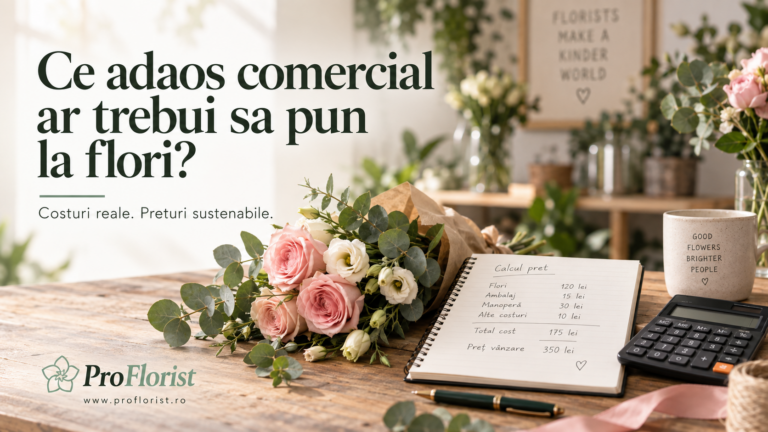
What commercial markup should I apply to flowers?
There is no universal commercial markup that is "correct" for all florists. A multiplier…
Business & Management / Software & Digitalisation
What do you check for a flower shop program if you work from your phone and computer
What you check in a flower shop program on phone and computer: orders, roles,…