Why choose local florists instead of high-commission platforms
When you order flowers online, the choice seems simple: you go to a website, choose a beautiful bouquet, pay, and wait for the surprise to reach the recipient. In reality, behind a flower order there is a much more complex chain: the florist who buys the flowers, the florist who prepares them, the packaging, the message, the delivery, the working time, losses from flowers […]
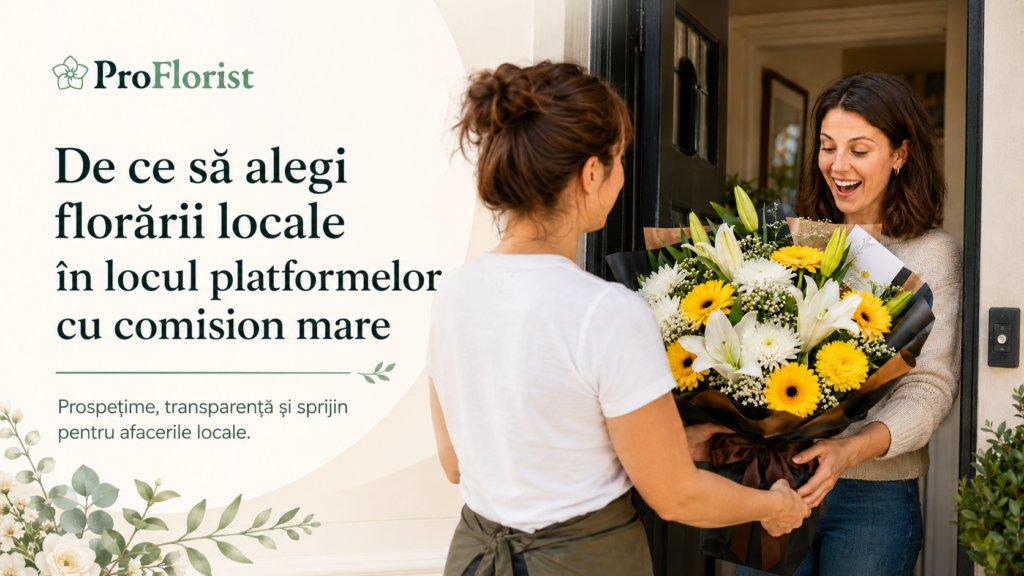
When you order flowers online, the choice seems simple: you go to a website, choose a beautiful bouquet, pay, and wait for the surprise to reach the recipient. In reality, behind a flower order there is a much more complex chain: the florist who buys the flowers, the florist who prepares them, the packaging, the message, the delivery, the working time, losses from perishable flowers and, sometimes, the high commissions of the platforms through which the order reaches the florist.
That is why the question “why choose local florists instead of high-commission platforms” is not just about price. It is about quality, freshness, transparency, and about how you want to support a fragile industry, built from people who work with living products. A flower is not a storage object. It cannot be stored for months on end, it cannot be shipped just any way and cannot be reduced to a simple margin on a table.
What is not seen behind an online flower order
For the customer, the flower order starts with a photograph. A pastel bouquet, a box with roses, an elegant basket, or a spectacular arrangement for an anniversary. For the florist, the order starts much earlier: with purchasing the flowers, checking their quality, proper hydration, cleaning the stems, preparing the packaging, managing inventory, and organising delivery.
Flowers are perishable products. This means that every day counts. If a rose is not sold on time, it loses its value. If a lily opens too quickly, it can no longer be used for certain orders. If a peony arrives too closed or too open, the florist must quickly decide how to integrate it or whether it can be delivered. In this context, a florist’s margin is never as simple as it seems from the outside.
When a large platform intermediates the order and takes a significant commission, the pressure usually falls on the florist. The customer sees the final price, the platform takes its share, and the florist has to cover the flowers, labour, losses, packaging, delivery, and responsibility towards the recipient. In the end, if the remaining price is too low, someone pays the difference: either the florist or the product quality, or the customer experience.
That is why choosing a local florist is not just a nice gesture of supporting a small business. It is a choice that can directly influence the quality of the bouquet you send.
FlorideLux experience: between local florist and international network
At FlorideLux, the experience was threefold. On one hand, there was the perspective of a local flower shop, with its own orders, its own clients, and its own pace of work; we also collaborated with many local florists in Romania for flower deliveries. On the other hand, FlorideLux also operated as part of larger networks, collaborating with local florists and being, in turn, a local florist for international platforms such as 1800Flowers, FloraPrima, or FloraQueen.
This position provided a very clear understanding of the system. From the outside, large platforms seem efficient: they collect orders, offer visibility, create workflows, and connect customers from one country with florists in another country. But from the inside, things are more complicated. The florist fulfilling the order has to support the most sensitive part of the process: the actual product, the real emotion, and the actual delivery.
The Romanian source described similar pressure in some international florist networks. According to that account, participating florists can face tension between service expectations, perishable stock, network fees and order values that do not always reflect local delivery costs. These conditions vary by network, market and contract and should be checked directly.
For the customer, all of this is invisible. He only sees a bouquet and a price. But for the florist, that price must cover an entire economic equation. When the equation no longer works, quality becomes vulnerable.
Why high commissions change the final quality
A high commission is not just a number in a contract. It is an amount that is deducted from the bouquet. It is deducted from the flowers used, from the time dedicated to the arrangement, from the packaging, from delivery, from the florist’s flexibility, and sometimes, from the willingness to make adjustments for the customer.
If a platform retains a significant percentage of the order value, the florist has to work with what remains. And what remains may be insufficient for a truly fresh, generous, and carefully made product. In such situations, the florist has several options: reduce the quantity of flowers, use cheaper flowers, limit working time, simplify the packaging, or accept a very small margin.
None of these solutions is ideal. If quality is reduced, the customer is disappointed. If the margin is reduced, the florist becomes unsustainable. If volume is forced, the team gets tired, and the service declines. In the long term, the model affects the entire industry.
Local florists survive on trust. They cannot operate healthily if every order becomes a race between low price, high commission, and premium expectations. A beautiful bouquet needs real resources. And real resources cost.
That’s why, when you choose a local florist, especially one that receives payment directly or works transparently, more of the order value stays where the bouquet is actually created. At the florist. In the workshop. In the flowers. In quality.
The local florist knows the city, the customer, and the delivery rhythm
An important advantage of local florists is proximity. The local florist knows the city, knows the areas they deliver to, knows how long a route takes at a certain time, and can realistically confirm if an order is possible. In Bucharest, this matters enormously. Traffic, distances, difficult parking, and delivery windows can completely change the experience.
A large platform may show fast delivery, but it is the local florist who has to execute it. They know if the bouquet can be prepared on time, if the flowers are available, if the recipient is in an accessible area, and if the delivery can be made without affecting the product’s freshness.
In addition, the local florist can communicate more humanly. They can say: “We don’t have exactly that flower today, but we can make a close variant with fresh flowers.” They can recommend a composition more suitable for the occasion. They can adapt the message on the greeting card. They can notice if a bouquet is too romantic for a corporate order or too solemn for a cheerful birthday.
These details are not always visible in an online checkout, but they are felt in the final result. A flower order is a personal gesture. And personal gestures need people, not just algorithms.
When the platform promises a lot, but the florist bears everything.
Large platforms have an obvious advantage: visibility. They appear in searches, have marketing budgets, clear interfaces, and standardised promises. For the customer, this may seem convenient. For the florist, however, working with such a platform can become difficult when the demands are high, the imposed prices are low, and the commissions reduce the real value of the order.
The florist is the one who has to fix any discrepancies between the platform’s photo and the locally available flowers. He also has to manage the stock, deliver on time, maintain quality, and indirectly fulfil a commercial promise that he has not always made himself. If the platform sells an ideal image, the florist has to turn it into reality with the remaining resources.
This tension is one of the major problems in the industry. When the customer pays enough, but the florist receives too little, frustrations arise on both sides. The customer expects a generous bouquet. The florist works with a limited budget. The platform remains the visible intermediary, but the emotional responsibility falls on the one who delivers.
That is why the direct relationship with the local florist is often healthier. The customer knows who prepares the bouquet. The florist knows what was promised. And the money goes closer to the actual work.
Why direct payment to the florist matters
A model in which the payment goes directly to the florist, where the flower shop accepts this flow, is fairer for everyone involved. The customer directly supports a local business, the florist keeps more of the value of their work, and the final product is more likely to be made with fresh flowers and genuine care.
This model does not eliminate the need for technology. On the contrary. A good platform can help the customer discover local florists, see products, compare options, and order more easily. But the major difference is whether the platform becomes an expensive intermediary or a fair bridge between the customer and the florist.
ProFlorist is intended to help customers discover local florists. Ordering, direct-payment and seller arrangements are available only where the current market flow explicitly enables them. The florist, availability, price, fees and contractual roles must be checked in the live offer before an order is placed.
In an industry with fragile margins, this difference matters. Not just for florists, but also for the quality of the customer experience.

How to correctly choose between a large platform and a local florist
Not all platforms are bad, and not all local florists are automatically excellent. The right choice is made carefully. Check who actually prepares the bouquet, if there is real communication, if the florist has recent photos, good reviews, and the ability to confirm availability.
If the platform doesn’t clearly tell you who delivers the flowers, if it promises anything anywhere, or if it displays products that seem too cheap for what they promise, it’s worth being cautious. Quality flowers, fast delivery, and good service have a real cost. When the price seems unrealistically low, it is very likely that the pressure is being transferred to the florist.
Instead, a local florist or a platform that works transparently with local florists can offer a fairer experience. You can receive confirmation, find out if the flowers are available, adjust the bouquet, and have more confidence that the product is made close to the recipient.
For important orders — anniversaries, birthdays, declarations, condolences, corporate events, or urgent surprises — this transparency is essential. You don’t just want to tick off an order. You want your gesture to be received well.
Choose local flowers, with more transparency and respect for the florist
When you choose local florists instead of platforms with high commissions, you are choosing more than just a bouquet. You choose to support the florist’s work, the freshness of the flowers, direct communication, and an experience closer to the reality of the product. In an industry where flowers are perishable, and the service requires time, care, and responsibility, every percentage matters. Through ProFlorist, the customer can discover local florists and can order more consciously, with greater transparency and respect for the people who turn flowers into emotion.
Related articles
More ideas from the same area
Business & Management / Florists & Stories
How to calculate the real margin on a flower bouquet
A practical method for calculating contribution margin from net revenue and the variable costs…
Business & Management / Florists & Stories
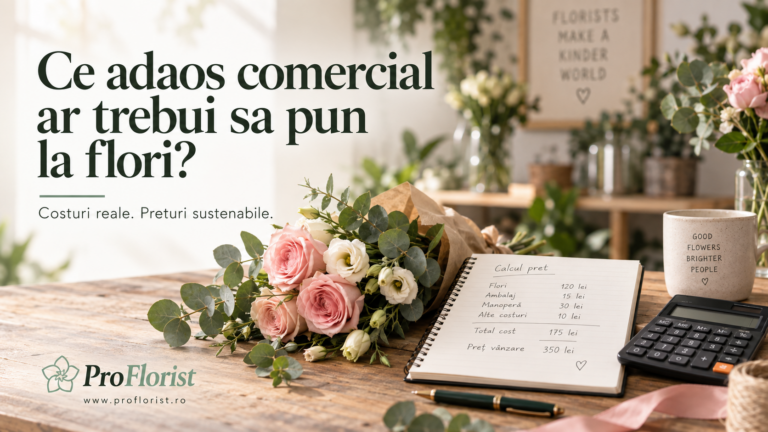
What commercial markup should I apply to flowers?
There is no universal commercial markup that is "correct" for all florists. A multiplier…

Ordering flowers in Bucharest without the hassle: how ProFlorist works
Ordering flowers for delivery in Bucharest may look straightforward, but availability, delivery areas, traffic…