Business & Management / Florists & Stories
Storing flowers in a florist shop: the right cold-room temperature
Flower storage involves controlling temperature, humidity and time outside the cold room. Many temperate cut flowers are commonly held at about 1–3°C, while tropical flowers may require warmer conditions; always follow species and supplier guidance.
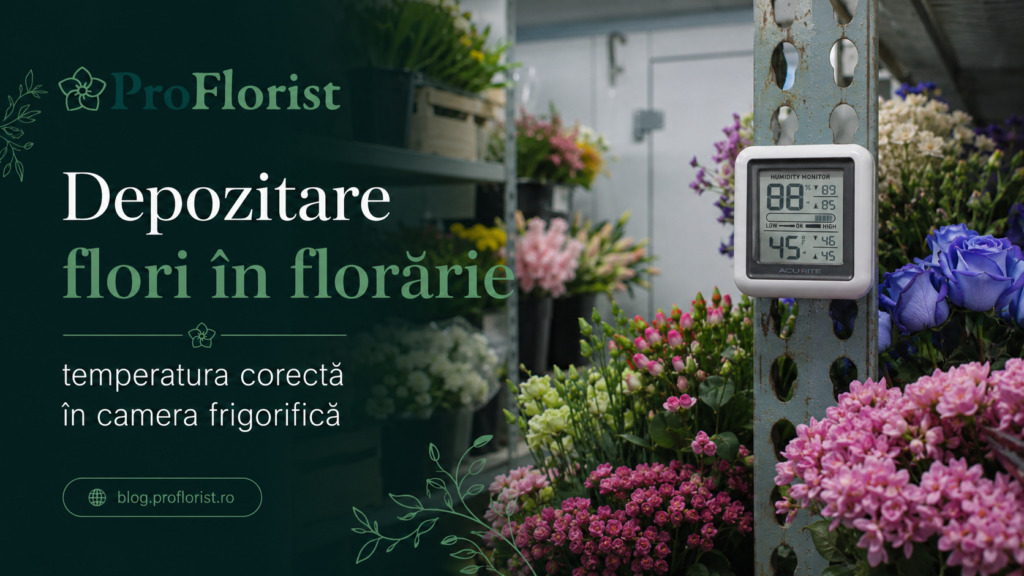
Storing flowers in a florist shop means more than simply “keeping them cold”. Temperature, humidity and time outside controlled storage all matter. Many temperate cut flowers are commonly held at around 1–3°C, while some tropical flowers and orchids require warmer conditions, often around 13–16°C. Suitable conditions vary by species, cultivar, handling stage and supplier guidance. Daily monitoring can reduce avoidable loss and help preserve vase life and product quality.
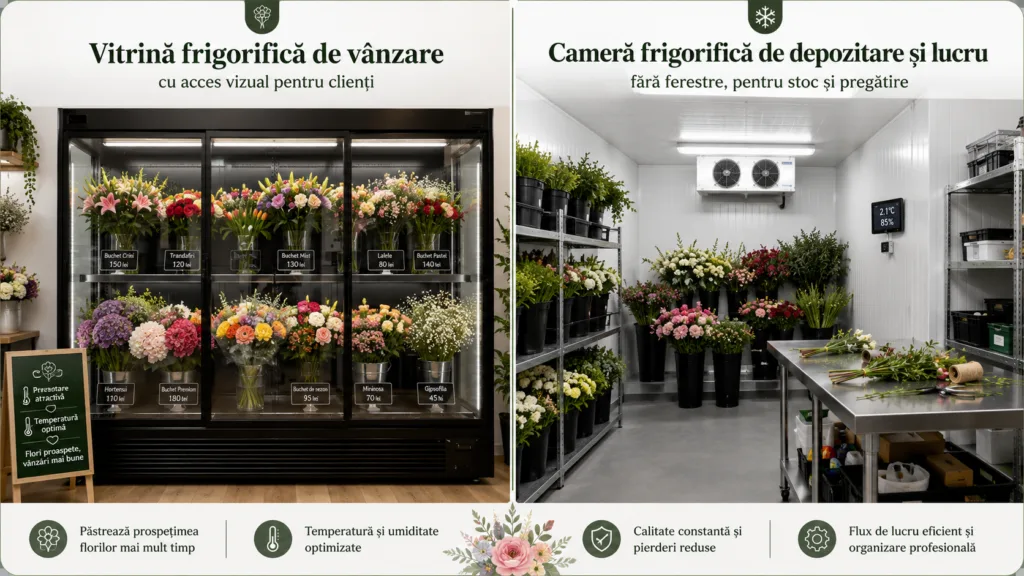
Refrigerated retail displays with customer visibility — In a flower display, presentation matters as well as cooling. Temperature should remain reasonably stable. A small display, for example with 2–4 m² of usable area, may use an integrated or compact system. Larger installations generally need a dedicated system designed and commissioned by a qualified refrigeration professional.
Windowless cold rooms for storage and work — Insulated cold-room panels are commonly used, with thickness selected by a competent designer for the room, external conditions and duty cycle; 80–100 mm is an example, not a universal specification. The floor should be washable and slip-resistant. The insulated door needs sound seals, reliable closure and an internal safety release. A busy shop considering a 5–8 m² room may need a separate condensing unit and correctly positioned evaporator. A refrigeration specialist must size, install and maintain the system in accordance with local rules.
Why refrigeration is one of the florist shop’s most important workers
Customers see beauty in the window, bouquets, website photographs and the moment flowers are received. Behind that beauty is a less visible factor that can help determine whether an order arrives in good condition: temperature. A cold room is not merely a technical space behind the shop. Used correctly, it is part of the shop’s quality-control system.
Cut flowers remain living material. After separation from the plant, they continue to respire, use stored energy and lose water. In general, higher temperatures accelerate biological processes. Buds may open faster, petals can lose firmness and vase life can shorten. The rate and response differ by species and prior handling.
Imported flowers may pass through growers, packing sites, warehouses, vehicles and receiving points before reaching a shop. Every stage can affect quality. A break in the temperature-controlled chain may not be immediately visible, and symptoms can appear later in the customer’s home.
For ProFlorist, flower storage and cold-room temperature are business issues as well as technical ones. Appropriate handling can mean less waste, fewer complaints and more consistent quality. In a market where customers compare prices, photographs and experiences, reliable freshness can support trust.
What temperature control means in a florist shop
A cold room is not simply switched on and forgotten. Temperature control is a continuous process covering receipt, unpacking, conditioning, storage, display and preparation for delivery. Product temperature and room air temperature may differ, so procedures and instruments should reflect the actual risk.
Flowers may look sound on arrival even after exposure to warmth in transport or on a loading area. Damage is not always immediate: petals can appear firm and leaves green, yet the bouquet may decline more quickly later.
Stability matters. Repeated movement between cold and warm conditions can create condensation, which in turn may favour Botrytis and other decay when susceptible material, moisture and suitable conditions coincide. A film of water inside sleeves or on petals can signal poor temperature management.
Do not wait until something looks wrong. Check and record conditions every day, just as you check stock and orders. Calibrated temperature sensors, a suitable humidity instrument and clearly assigned responsibility can prevent substantial losses. Alarm limits and corrective actions should be set with a competent specialist.
Cold-room temperature for temperate cut flowers
For many temperate cut flowers, guidance commonly places cold storage around 1–3°C, approximately 34–38°F. Cooling slows respiration and water loss, but the correct set point depends on species, cultivar, storage duration, packaging and whether flowers are held wet or dry. Follow authoritative crop-specific and supplier instructions.
Cold storage is not the same as freezing. Temperatures at or below a product’s freezing or chilling-damage threshold can cause permanent injury. Symptoms may include translucent petals, soft patches, spotting or burnt-looking edges; sometimes deterioration only becomes obvious after the flowers warm up.
Relative humidity is also important. The source article gives 75–85% relative humidity as a general working range, but published recommendations can vary and many flowers are managed at higher humidity under controlled conditions. Air that is too dry increases water loss; excessive surface moisture and poor ventilation increase disease risk. Obtain crop-specific professional guidance rather than applying one figure to every flower.
Cold air should circulate without a strong draught striking sensitive flowers. Direct airflow can dehydrate petals. Containers need spacing for circulation, and the room should not be packed beyond its design capacity. A thermostat reading alone does not prove that every part of an overloaded room is within specification.
Warm conditions generally increase respiration and speed development. Buds may open earlier, stored reserves are used faster and vase life can be reduced. The practical impact depends on time, temperature and the sensitivity of the material.
Exposure often occurs during receipt, conditioning or dispatch: boxes remain on a bench, beside a door, near a heat source or in a sunny display. Strong lighting can also add heat, so shop lighting and window exposure deserve attention. During busy periods, define maximum out-of-cooler times and organise work so products return promptly.
Ethylene is a plant hormone involved in ripening, senescence and stress responses. Some flowers are highly sensitive to ethylene, and exposure can cause petal drop, yellowing or early wilting. The linked source discusses ethylene oxide rather than post-harvest ethylene, so use a specialist floriculture reference for control guidance. Potential sources include ripening fruit, damaged plant material, exhaust and ageing flowers.
A cold room must be clean as well as cool. Remove damaged flowers, manage vase water according to hygiene procedures, cut stems correctly and clear plant debris before it decays. Poor sanitation can undermine quality even when air temperature is suitable.
Tropical flowers, orchids and cold-sensitive species
Tropical flowers originate in warmer environments and some suffer chilling injury at temperatures that suit temperate crops. Symptoms can include spotting, darkening or water-soaked soft areas that cannot be reversed. These signs are sometimes mistaken for a lack of freshness.
Orchids, anthuriums, heliconias, strelitzias and other tropical materials may require separate handling. Where volume justifies it, use separately controlled storage. Otherwise, zoning, short holding times and clear supplier instructions can reduce risk. Do not assume that every orchid or tropical species has the same temperature requirement.
Professional floristry therefore combines visual judgement with an understanding of plant biology and post-harvest care.
Organising a cold room with mixed stock
Keep cold-sensitive species away from the coldest points and direct fan discharge. More tolerant products may be placed nearer the airflow where appropriate, while delicate flowers need protection. Label containers clearly, especially for new staff, and note special handling requirements and processing dates.
Treat the cold room as a managed workspace, not an accidental store. Make first-out stock accessible, separate event material from daily retail stock and inspect higher-risk products more often. Do not hide older flowers at the back, where deterioration can contaminate water or neighbouring material.
This is part of a modern retail discipline: a florist manages valuable, perishable stock. A well-organised cold room can reduce waste and improve control over gross margin, although it cannot compensate for poor purchasing or damaged incoming goods.
Daily team checklist
check and record cold-room temperature;
check relative humidity where it is a controlled parameter;
look for condensation on flowers and sleeves;
remove damaged or decaying flowers;
change or manage water where required;
clear plant debris and clean surfaces;
separate tropical and cold-sensitive flowers;
inspect the door, seals, alarm and internal release;
record problems in the internal log or approved team channel.
Many losses arise not from a lack of advanced knowledge but from missed daily controls. Small teams handle many tasks at once, so checklists may initially feel rigid. In practice, clear responsibilities save time, support traceability and help the team respond consistently.
Floristry remains an emotional craft, but profit also depends on discipline. One of the simplest disciplines is knowing and documenting the conditions required by each flower you store.
Related articles
More ideas from the same area

Business & Management / Florists & Stories
What commercial markup should I apply to flowers?
There is no universal commercial markup that is "correct" for all florists. A multiplier…

Business & Management / Florists & Stories
How to calculate the real margin on a flower bouquet
A practical method for calculating contribution margin from net revenue and the variable costs…

Romanian florists: professional standards, burnout and the need for digital tools
This continuation of the AADF discussion looks beyond polished bouquets and social-media images to…