Business & Management / Supply & Flower Industry
The future of florists is digital: the reality behind a global industry in transformation
The global floristry industry is no longer defined by tradition, but by transformation. Market data, reports from major industry players and changing consumer behaviour point to one clear conclusion: the future of florists is not merely online — it is deeply digital. […]
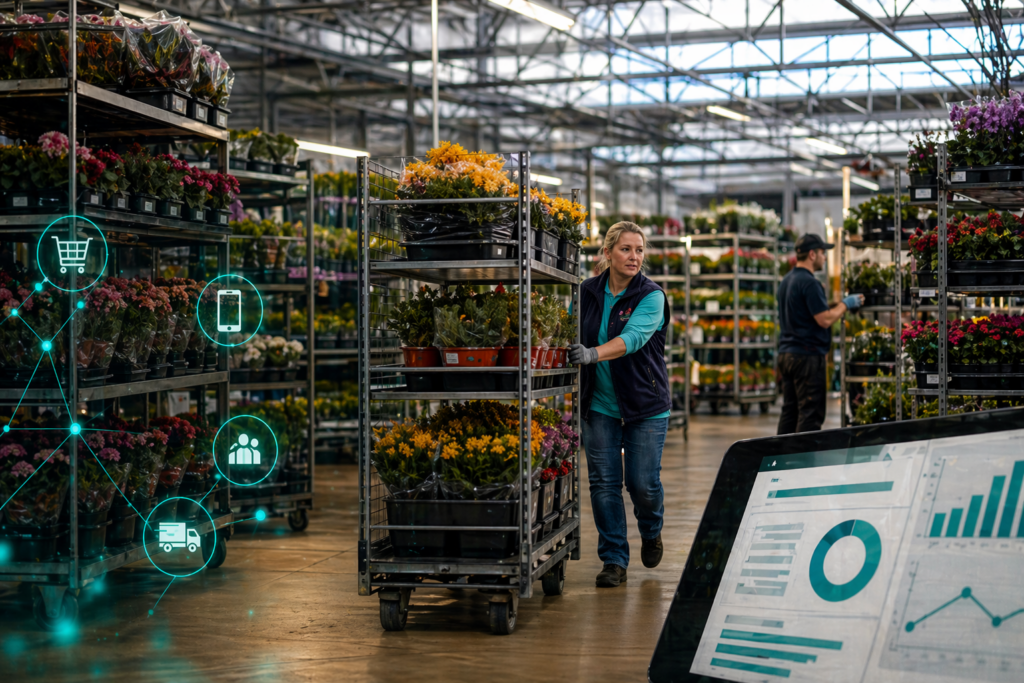
The global floristry industry is no longer defined by tradition, but by transformation. In recent years, the changes have not simply been visible — they have been structural. Market data, reports from major industry players and changing consumer behaviour point to one clear conclusion:
the future of florists is not merely online — it is deeply digital.
This conclusion is not an opinion. It is supported by developments at Royal FloraHolland, one of the industry’s most important global organisations, as well as by international market data.
A growing global industry under pressure
The global floristry market was estimated at more than USD 60 billion in 2025, with projections exceeding USD 100 billion by 2035 and annual growth of approximately 5%.
At the same time, there is a major contradiction:
- demand is growing
- but pressure on growers and traders is also increasing
According to the latest Trend Report Floriculture published by Royal FloraHolland:
- almost 70% of growers consider regulation their greatest challenge
- energy costs and price volatility are critical factors
- margins remain under constant pressure
This means the traditional model is no longer sustainable without adaptation.
Digitalisation: not a trend, but a structural necessity
Royal FloraHolland’s official report identifies two dominant directions for the industry’s future:
- digitalisation
- sustainability
Furthermore, approximately 45% of industry participants say they intend to invest in modernisation and digital platforms.
This is not experimental adoption.
It is a reconfiguration of the entire value chain.
From physical auctions to global digital platforms
To understand the scale of the change, we need to examine the industry’s infrastructure.
Royal FloraHolland processes billions of flowers each year and represents one of the world’s largest trading hubs, where transaction speed is essential.
This infrastructure is becoming increasingly digital:
- transactions carried out through digital platforms
- real-time logistics integration
- automation of distribution processes
One concrete example: in the period before Valentine’s Day 2026, more than 464 million flowers were traded in an extremely short period through a system combining digital processes with global-scale logistics.
Without digitalisation, managing such a volume would be impossible.
The market paradox: less volume, more value
Royal FloraHolland’s reports provide another important signal:
- volumes may fall
- while average prices rise
This phenomenon indicates a profound change:
the market is no longer about quantity, but about efficiency and value.
Higher average flower prices contributed directly to better financial results in 2024, and the trend has continued.
This favours businesses that:
- control the sales chain
- optimise costs
- use data and digital systems
Sustainability accelerates digitalisation
Sustainability is another major pillar of the transformation.
- more than 84% of growers have adopted sustainable practices
- the use of harmful substances has fallen significantly — by as much as 78% in some cases
- 74% of participants are positive about the environmental transition
But sustainability brings cost and complexity.
This is where digitalisation becomes essential:
- for traceability
- for resource optimisation
- for transparency
The real change: from product to system
The most important transformation is not technological, but conceptual.
The floristry industry is moving from:
- selling products
to:
- operating integrated systems
Today, success is no longer determined by:
- how beautiful the bouquet is
but by:
- how quickly it reaches the customer
- how efficient the logistics chain is
- how well the customer relationship is managed
The impact on local florists
This global transformation has direct implications for florists:
1. Competition is no longer local
Florists compete with:
- online platforms
- marketplaces
- international brands
2. Margins are becoming more fragile
Upstream pressures — growers, energy and logistics — are passed on to retailers.
3. Digital becomes the main differentiator
Florists that:
- have their own systems
- control the customer relationship
- use digital marketing
→ will be better placed to lead their local markets.
The future: florists as digital businesses
All the data points towards the same conclusion:
the florist of the future is not simply a shop — it is an integrated digital system.
It will include:
- its own e-commerce
- customer databases
- automation
- logistics integration
- recurring marketing
This is precisely the direction in which the entire industry is evolving, from growers to retailers.
Digital transformation in floristry is not optional, nor is it a temporary trend.
It is the direct result of:
- economic pressures
- changes in consumer behaviour
- global technological development
The message communicated by Royal FloraHolland is also clear:
the industry’s future will be built on digitalisation, efficiency and integration.
For florists, the question is no longer whether they need to adapt.
It is:
how quickly they can make this transition.
Related articles
More ideas from the same area

Business & Management / Florists & Stories
How to calculate the real margin on a flower bouquet
A practical method for calculating contribution margin from net revenue and the variable costs…

Business & Management / Florists & Stories
What commercial markup should I apply to flowers?
There is no universal commercial markup that is "correct" for all florists. A multiplier…

Business & Management / Software & Digitalisation
Excel or flower-shop software? Comparing organisation, costs and limitations
A practical comparison of spreadsheets and dedicated flower-shop software. Product functions, packages and availability…