Business & Management / Supply & Flower Industry
Flower-shop purchasing and floral recipes: a step-by-step guide
Reliable purchasing and clear floral recipes can help a flower shop plan stock, measure wastage and understand product costs. The guide assumes no particular supplier, legal structure or guaranteed margin.
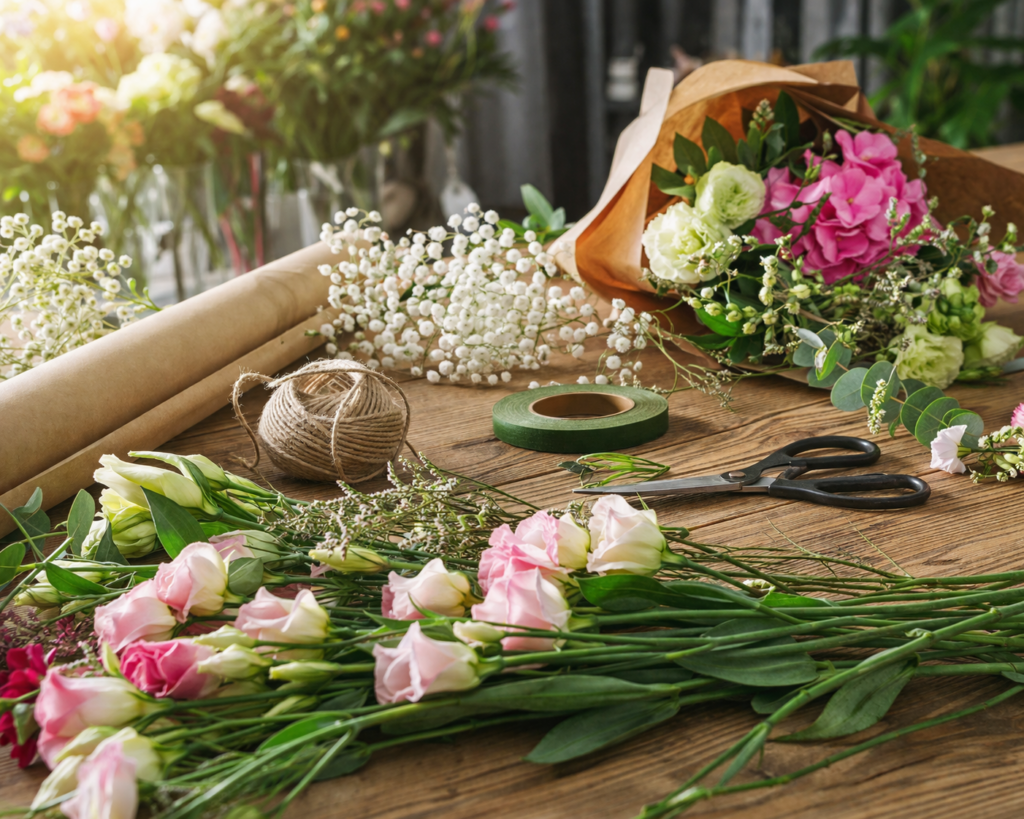
The supply of a florist is the basis for a sustainable business and a correct flower recipe can make the difference between profit and loss. From the calculation of the need for flowers and greens, to the choice of suppliers and tool management, each step counts. In this article, you can discover how to plan the supply of your flower shop and how to create a recipe for a professional bouquet, so as to transform the passion for flowers into a business with real results.
Why supply and floral recipes make a difference
Anyone who dreams of opening a flower shop or already manages a company in the field knows that the creative part – spectacular arrangements, colourful bouquets and excitement – is just the tip of the iceberg. In the back there’s a whole strategy that starts with the flower supply. The choice of suppliers, stock planning and knowledge of flower seasonality are key elements for the business to be profitable and for each customer to receive quality products.
Equally important is the floral recipe, an apparently technical concept, but it actually hides the balance between aesthetics and economic efficiency. Each bouquet has a prescription: number of main flowers, types of greens, fillings and packaging required. For example, if you want to make a bouquet of 17 roses, you have to think about the supply depending on how flowers are sold – roses come in packs of 10, greens in ties of 10, and eucalyptus in grams or bonds. This rigorous planning not only ensures the quality of the bouquet, but also reduces waste and financial losses.
ProFlorist aims to offer Romanian florists a community of learning and support. Through educational resources and the exchange of experience between professionals, the application helps local florists to become more competitive, efficient and connected with the reality of a dynamic market.
Profit business with flowers: is it profitable to have a florist in the local market?
In the following rows, you will learn step by step how to make the correct supply of a flower shop, how to build a bouquet recipe, how to organise your tools and accessories, but also how to increase profit by reducing losses. Everything in a friendly setting, adapted to the Romanian florist who wants to combine creativity with the rigor of a modern business.
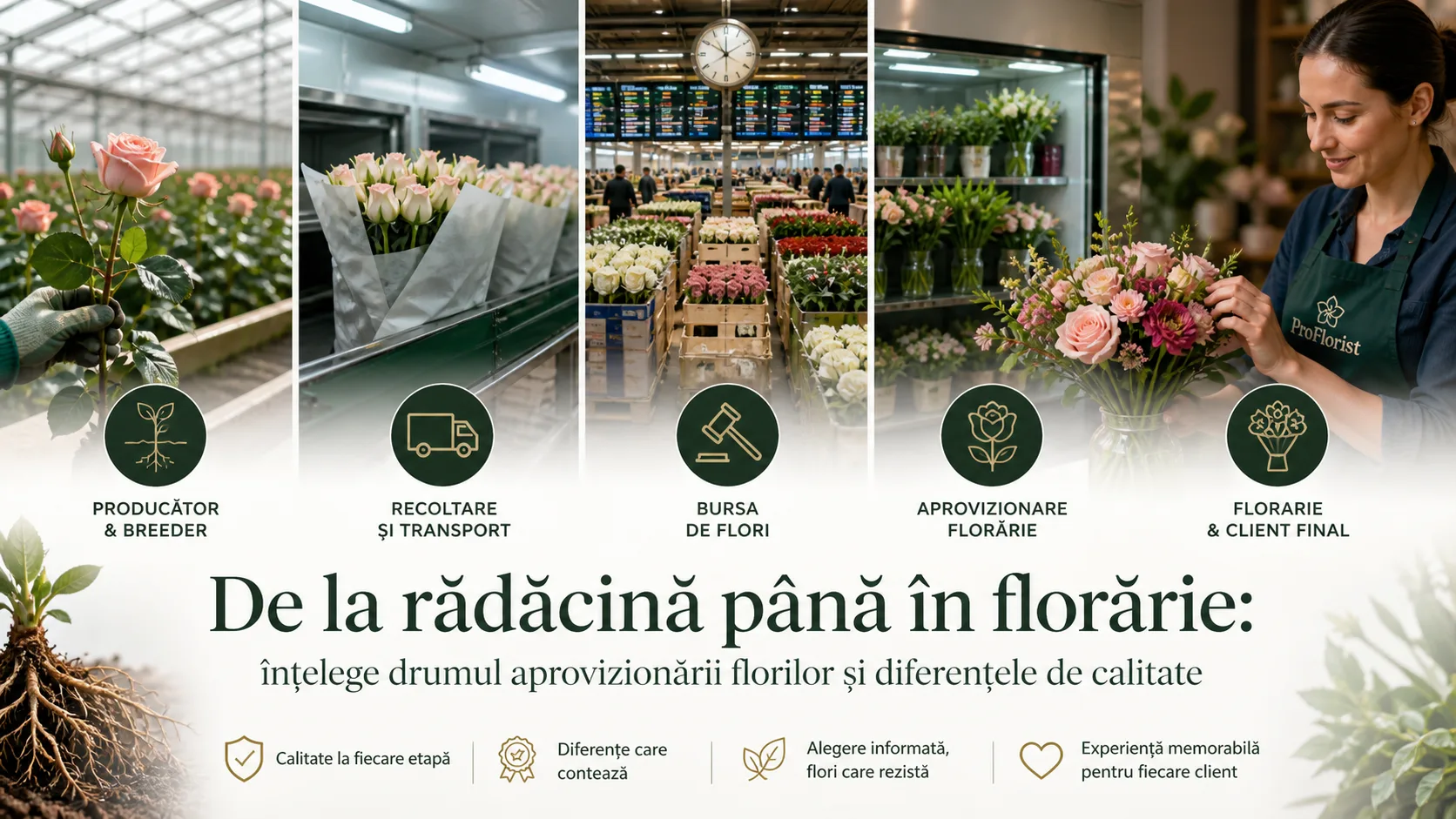
Floristry business — how to purchase stock
- Floral tools
- Floral sponge
- Packages, bunches, raffia
- Vases, vases, boxes
- Special, thematic or seasonal accessories
- Main flowers, fillings, greens
Florist supply and how to make a step-by-step floral recipe
Why is the correct supply important in a flower shop
The correct supply is the foundation of a flower business. Behind each beautiful bouquet there is a chain of carefully thought-out decisions: from the chosen suppliers to the way the flowers are stored and used. A shop that supplies itself chaotically ends up losing money, having withered products and dissatisfied customers. Instead, efficient planning brings stability and profit.
Flowers are extremely perishable products. A rose, however fresh at the time of purchase, has a limited life cycle. If the florist does not know exactly how many customers he has daily and what types of bouquets are preferred, the risk of loss increases. Therefore, supply must be adapted to real demand and seasons.
You might also be interested: Code caen florarie Rev 3 – What is important to know when updating your code CAEN al & nbsp; florarii & nbsp; tale
Impact of supply on the profit and success of a flower business
The profit of a florist comes not only from creativity, but also from mathematics. A flower shop company that buys more than it needs to lose money on every pack of discarded flowers. Instead, if the supply is calculated correctly, each flower becomes part of a sale and the profit margin increases. A well-organised flower shop ends up reducing losses to less than 10%, making the difference between a business that survives and one that develops.
Difference between market supply and wholesale deposits in the local market
In Romania, many florists supply either from the flower market or from wholesale deposits. The market has the advantage of diversity and flexibility, but prices can be higher and quality unequal. Wholesale deposits offer stability, large lots and the possibility to work with direct importers from the Netherlands or other countries, which guarantees freshness and competitive prices. The right choice depends on the florist’s strategy, but the combination of the two sources can bring balance.
How you plan to supply a modern florist
Supply planning is not random. It involves a careful analysis of sales, seasonality and type of customers. In a small town, the demand for sophisticated arrangements can be reduced, while in Bucharest or Cluj, customers seek diversity and novelty.
The experienced florists build their tables and graphics with sales from past years to anticipate the need. For example, on 8 March, large volume roses and tulips are ordered, while in December the demand for tree branches, ilex and exotic flowers is increased.
Calculation of required per week by season and type of customers
A basic rule is to calculate weekly supply on the basis of firm orders, to which you add a safety percentage. If you know that you sell, on average, 50 bouquets a week, each with 10-15 flowers, you can set minimum requirements. In peak times like Valentine’s Day, you have to double or even triple the stock.
How to choose suppliers and build trust relationships with them
A good flower supplier is not only low prices, but also serious. The relationship between the florist and the supplier must be one of partnership. It is essential to have the guarantee that flowers are delivered on time and under optimal conditions. In addition, a reliable supplier can offer you advice on trends, seasonality and quality. In Romania, many florists combine local suppliers with established importers to have diversity.
Floral recipe – the basis of any sustainable flower business
A flower recipe is like a kitchen recipe: it shows you exactly what ingredients you need for a bouquet or an arrangement, in what quantities and at what cost. It helps the florist to know from the beginning how much the product costs him and what addition he needs to apply to make a profit.
How to make a recipe for a bouquet of flowers step by step
Suppose you want to make a bouquet of 17 green roses. The first step is to think about supply according to sales units. Roses come in packs of 10, so you’ll go into 20 roses, even if you use 17. The green, like the fern, comes to the 10-thread bond, so you write down 10, even if you only use 3. The eucalyptus can be sold on a link or on a scale; you will pass the minimum amount available. Add packaging, bow and other accessories, and at the end the total cost of the bouquet.
Practical examples: bouquet with roses, greenery and fillings
You must always include filling flowers, such as gypsophila, solidago or wax flower, in the floral recipes. They not only give volume to the bouquet, but also save situations where the main flowers are smaller or unflowered. Extra greens – such as fun, eucalyptus or pistachia – complete the final image. A correct recipe allows you to have a realistic picture of costs and to set the selling price correctly, avoiding losses.
Organisation of stock and tools required in the flower shop
A well-organised flower shop means not only beautiful flowers exposed to the window, but also a clean deposit with updated inventory and handy tools.
How to manage greens, fillings and packaging
Green is a key element and must be stored in optimal conditions. If hydrated correctly, it can take even two weeks. Packages must be kept in categories – paper, foil, boxes, bunches – so that the florist can easily find them when creating a bouquet. Filling flowers, such as gypsophila or solidago, are frequently used, so it is good to always have a spare stock.
Essential tools for a flower shop
A professional florist always has at hand the rose cleaner, the stem scissors, ribbon scissors and a special knife for flowers. The floral sponge and the right vessels are required for arrangements. Tools not only make work easier, but also accelerate the creation process, which means more satisfied customers in a short time.
How to increase profit in a florist by efficient supply
The correct supply is closely linked to profitability. Overbought flowers lead to losses and insufficient stocks lead to dissatisfied customers. Balance is key.
Techniques to reduce losses and optimise stocks
A trick used by florists is to always order an extra greenery and filler flowers that can save the bouquets when the main flowers are fewer. The use of management applications also allows tracking of stocks and anticipating the need. Losses can also be reduced through last-minute offers: low-price bouquets for loyal customers when flowers are approaching the end of their lifetime.
Strategies to make money with a florist and loyalty to customers
Loyalty clients are the engine of a flower business. An effective strategy is to create flower subscriptions – weekly or monthly deliveries to individuals or companies. Thus, you ensure constant sales and can plan your supply better. In addition, transparency towards customers – explaining to them what flowers are in the season and why a bouquet costs a certain amount – builds trust and loyalty.
The role of the florist community and the exchange of know-how in the local market
Floristry is not just a profession, but a community. Florists in the local market started working together more, sharing their experiences and learning from each other.
Sources of education and information for florists through ProFlorist
ProFlorist is not only a community, but also an educational platform. Here florists find articles, guides, flower recipes and information about the supply of a florist. In addition, the virtual community allows them to ask questions and receive answers from other professionals.
How the florist network contributes to local flower business development
The Romanian florist network brings together experiences and practical solutions. A florist from Iasi can share storage techniques with one from Timisoara, and someone from Bucharest can offer advice on how to manage your orders online. This collaboration raises industry-wide standards and makes flower business more competitive.
Frequent questions about the supply of a florist
How do I plan my supply for a small flower shop?
Supply planning in a small flower shop is based on seasonality and type of customers. Recommended is to start with a weekly calculation of the need for main flowers, greens and packaging. So you reduce losses and you always have fresh products, which gives you a healthy flow for your flower shop and a constant offer for customers.
Where can a flower shop source flowers?
In Romania, the difference between market and wholesale supply is significant. Markets can offer variety, but wholesale deposits bring flowers directly from the Netherlands or from local producers at better prices and with guaranteed freshness. For a stable flower business, constant supply from warehouses is the optimal solution.
What is a floral recipe and how does it help me in the business?
A flower recipe is the structure of a bouquet: how many main flowers contain, what greens and fillings are used and what type of packaging completes it. By calculating the recipe, you know exactly the cost and final price of the product. This method helps you manage stocks efficiently and increase profits in a modern flower shop.
How do I reduce the loss of flowers in a flower shop?
Losses are reduced by a calculated supply and using older flowers in promotional bouquets or last-minute arrangements. Daily stock monitoring and adjustment of orders to calendar events are essential. Thus, a flower shop optimizes its expenses and retains a high level of quality for customers.
What tools are indispensable in a flower shop?
A florist needs professional scissors, special knives, floral tape, wire, sponge and pliers. They make the difference in the speed and quality of the work. A well-organised flower shop invests in quality tools to make time more efficient and ensure a constant standard of bouquets delivered to customers.
Join the ProFlorist community
ProFlorist is a true community of florists from all over Romania, created to support the growth of orders, profitability and interaction between florists. We want to build together a proactive and profitable space for the entire flower industry, where every florist will gain. Be among the first to discover the advantages of the new network – contact us on members @ proflorist.ro or watch us on social networks for news about the florist industry.
You might also be interested:
Related articles
More ideas from the same area

Business & Management / Florists & Stories
How to calculate the real margin on a flower bouquet
A practical method for calculating contribution margin from net revenue and the variable costs…
Business & Management / Florists & Stories
What commercial markup should I apply to flowers?
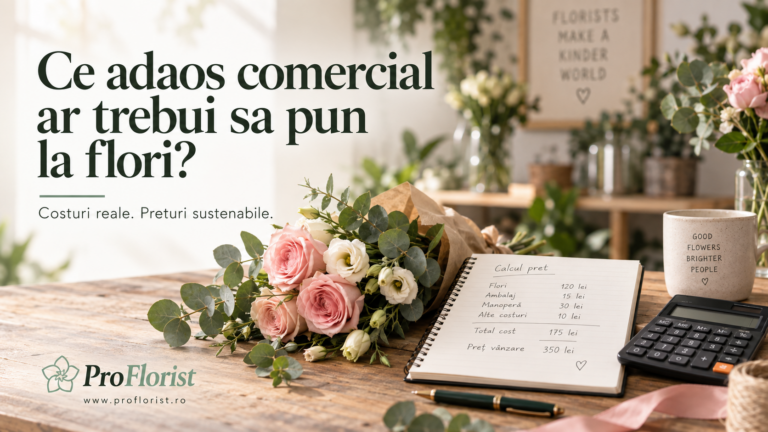
There is no universal commercial markup that is "correct" for all florists. A multiplier…

Florists & Stories / Supply & Flower Industry
Ten lessons from ProFlorist’s “Coffee with Florists” invitation
Archive note: the source invitation contains conflicting year references, including 2026 and 2027. This…