Business & Management / Supply & Flower Industry
Valentine’s Day 2026 statistics for the flower industry – includes charts and market analysis
Valentine's Day is not just a holiday. For the floral industry, it is an annual test of endurance, organisation and adaptation. It's the time when everything accelerates: orders, pressure, customer expectations and, perhaps most importantly, the dependence on a logistics chain that must function perfectly. Every year, this period tells a story about the industry. [...]
Valentine’s Day is not just a holiday. For the floral industry, it is an annual test of endurance, organisation and adaptation. It’s the time when everything accelerates: orders, pressure, customer expectations and, perhaps most importantly, the dependence on a logistics chain that must work perfectly.
Every year this period tells a story about the industry. And Valentine’s 2026 is no exception.
Based on feedback collected from florists in mature markets such as North America, but reflected increasingly clearly in Romania, some important directions are emerging: a more organised but still vulnerable industry, predictable but unpredictable customers in actions and increasing pressure on margins and efficiency.
This is not just a report. It is a mirror of reality in flower shops.
Florist confidence before Valentine’s: better preparation than other years
One of the most interesting signals is the level of confidence with which florists entered the season.
Approximately 77% of respondents said they felt prepared — either “very confident” or “fairly confident” — about product availability and supplier relationships.
What does this actually mean?
It means the industry is starting to learn from mistakes. After years of logistical bottlenecks, stock shortages and operational chaos, florists have adjusted their behaviour:
- they ordered earlier
- they communicated better with suppliers
- built more stable relationships
And perhaps most importantly: they started treating Valentine’s as a logistics project, not just a sales opportunity.
In Romania, this is starting to be seen more and more clearly in the constantly growing flower shops.
What really matters when choosing providers
Another extremely relevant insight: quality remains the main criterion.
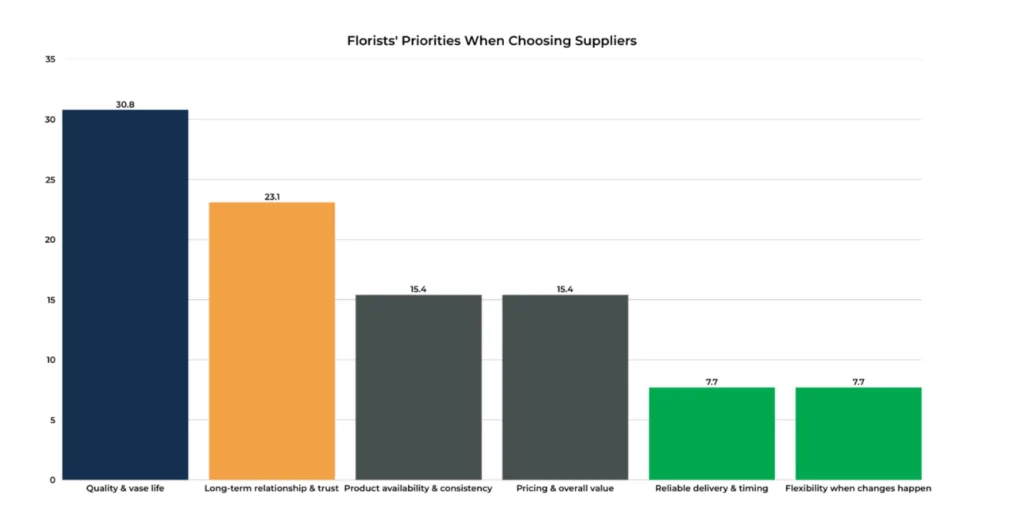
Over 30% of florists indicated flower quality and lifespan as the deciding factor, followed by long-term relationships and trust in the supplier.
Not the price.
And here is an important lesson for the Romanian market, where the competition is still, in many cases, on low prices.
The reality is simple: during peak periods, weak flowers destroy your reputation faster than any marketing campaign.
The lesson: the provider is not a cost. It’s an extension of your brand.
The real problems before Valentine’s: not the flowers, but the people
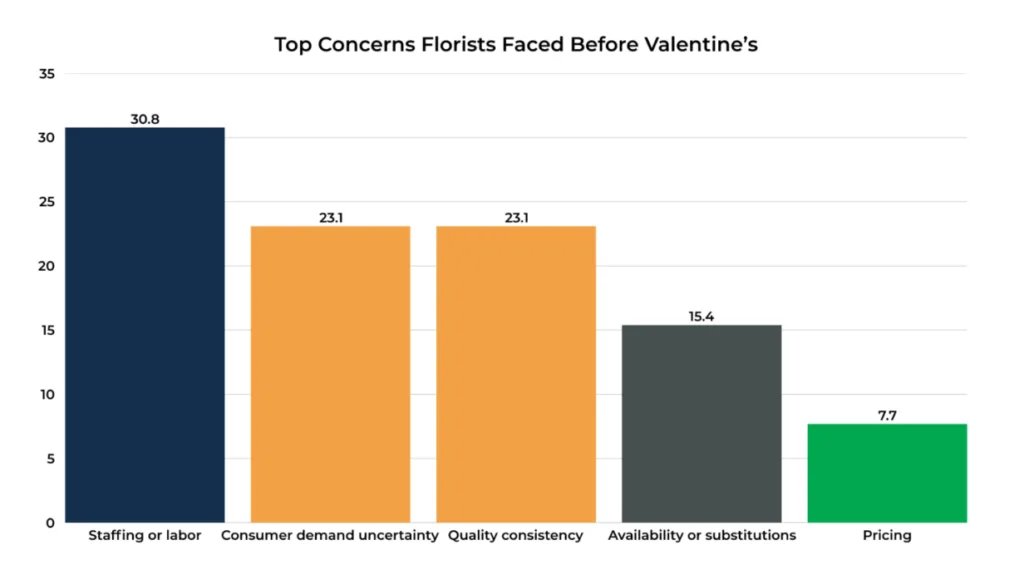
Prior to the season, the main fears weren’t about merchandise or prices.
Many people.
The florists indicated as the main challenges:
- lack of staff
- demand uncertainty
- maintaining quality in high volume
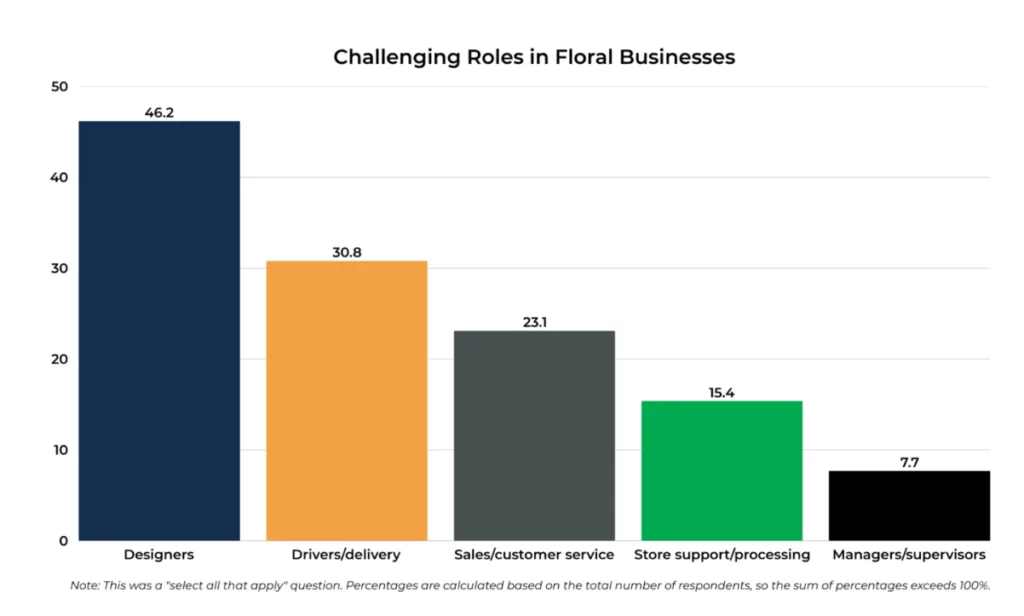
And the most difficult role to cover? The floral designer.
Not the delivery person. Not the seller.
The designer.
Because in the end, the difference between a florist that survives and one that grows is not how much you sell, but how what you sell looks like.
What Really Happened in Valentine’s 2026
After Valentine’s, the picture is surprisingly stable.
About 70% of florists said the results were at or above expectations.
This means one important thing: the planning worked.
But not without challenges.
The problem that keeps coming up? Margins.
Costs are rising — transportation, import, labour — and prices can’t rise as fast, especially in a price-sensitive market like Romania.
Herein comes the real challenge of the coming years: how to stay profitable without going “cheap”.
What Really Happened in Valentine’s 2026
After Valentine’s, the picture is surprisingly stable.
About 70% of florists said the results were at or above expectations.
This means one important thing: the planning worked.
But not without challenges.
The problem that keeps coming up? Margins.
Costs are rising — transportation, import, labour — and prices can’t rise as fast, especially in a price-sensitive market like Romania.
Herein comes the real challenge of the coming years: how to stay profitable without going “cheap”.
The truth that everyone knows: orders come in at the last minute
Perhaps the most frustrating, but also the most constant insight:
👉 Approximately 70% of orders come at the last minute.
Although florists hope every year for a more balanced distribution, customer behaviour does not change.
This affects everything:
- the stocks
- the staff
- deliveries
- team stress
And it won’t change anytime soon.
The lesson: don’t build strategies on “how the customer should be”, but on how the customer actually is.
Operational stability: the sign of a maturing industry
Another positive signal: most florists said that:
- they had the stocks on time
- deliveries worked
- the weather did not significantly affect operations
Approximately 77% stated that the supply was done correctly in terms of timing.
This is probably the most important advance.
Because an industry that works logistically well is an industry that can grow.
What do all these things mean for florists in Romania
Even if the data comes from foreign markets, the reality is closer and closer to Romania.
And the conclusions are clear:
- the market becomes more competitive
- margins become more fragile
- customers do not become more “disciplined”
- organisation makes the difference, not luck
But perhaps the most important change is this:
- florists who treat the business as a system will win
- those who treat him as a “talent” will be left behind
Related articles
More ideas from the same area

Business & Management / Florists & Stories
How to calculate the real margin on a flower bouquet
A practical method for calculating contribution margin from net revenue and the variable costs…

Business & Management / Florists & Stories
What commercial markup should I apply to flowers?
There is no universal commercial markup that is "correct" for all florists. A multiplier…

Business & Management / Software & Digitalisation
Invoicing, inventory or florist management software: what each system does
The difference between invoicing, management and florist management. How documents, stock, orders and production…