Business & Management / Software & Digitalisation
How to calculate the price of a flower bouquet correctly
A practical pricing method based on usable flower cost, greenery, consumables, direct labour, wastage and other order-specific costs. Figures are illustrative; validate local taxes, overheads and assumptions before setting a selling price.

The correct price of a bouquet is calculated from the actual cost of the flowers that can be sold, to which you add greenery, consumables, direct labour and other variable costs generated by the order. Then you set the price for the desired margin, don’t automatically apply an arbitrary multiplier.
In ProFloristThe price of a bouquet must not start from an isolated figure, but from what really composes it. The platform allows you to organise products with variations and prices, to work with recipes and ingredients and to keep track of the flowers in the inventory by types, colours and variants, so that you have a clearer basis when determining what can be produced and at what price it is worth selling. The connection between catalog, recipe, ingredients, stock and availability helps you to view each bouquet as a product that needs to be understood economically, not just aesthetically: how many wires you use, what materials you enter it, what you have available and how easily the same recipe can be repeated. ProFlorist does not replace the financial decision of the florist owner, but puts in one stream the operational information you need to calculate the real cost more disciplined, to update the prices when the recipes or ingredients change and to avoid the situation in which a product looks good in the catalog, but is not sustainable for business.
Looking How do I correctly calculate the price of a bouquet of flowers? The basic formula is:
Net price = relevant cost / (1 & # 8211; desired margin)
For a VAT-paying florist, margin analysis is usually more useful on values without VAT. Rent, software, accounting and other fixed costs should not be ignored: the margin generated by sales must be sufficient to cover them.
Why is “flower price × 3” not enough?
One of the most widespread ways to determine the price of a floral arrangement is to apply a multiplier to flowers.
You bought 50 lei flowers? You multiply them by 3 and sell the bouquet for 150 lei.
It’s simple. That’s why it’s tempting.
The problem is the bouquet doesn’t just contain the flowers on the bill.
Contains paper, ribbon, greenery, working time, damaged flowers, supply transport, possibly a box, a card and payment processing. If sold online, it may contain economic and customer purchase cost, payment fee, additional packaging and delivery.
The Society of American Florists notes itself that there is not a single solution suitable for the entire industry. The type of florist, the market, positioning and cost structure changes mathematics.
The multiplier can be used as a quick check if a florist has already built its economic model and knows what that multiplier covers.
But it shouldn’t be the starting point.
The correct question is:
How much does it really cost me to produce and sell this bouquet and what’s left after the sale?
Do you want to have more control over the products and prices in your flower shop?
With ProFlorist you can organise in one place the products, variants, recipes, ingredients and availability of flowers, so that you have a clearer picture of what you are selling and how each product is built. If you want to reduce decisions made “out of the eye,” work more disciplined with recipes and better organise your catalogue and production, discover ProFlorist and see how he can sustain the daily operations of your florist.
What is the real cost of a bouquet?
A bouquet has several cost layers.
Cost of flowers
You start from:
- the main flowers;
- secondary flowers;
- green;
- vegetable materials;
- decorative elements.
But you have to look at real purchase costNot just at the nominal price of a wire.
Romanian accounting regulations include in the purchase cost the purchase price and, when they are directly attributable, transport, handling and other costs associated with the purchase. Trade cuts reduce cost.
If you have paid 500 lei for the flowers and 50 lei for direct transport related to the supply, management analysis should not act as if the flowers only cost 500 lei.
Supplies
A floral product may also consume:
- paper;
- foil;
- the ribbon;
- tape;
- wire;
- floral sponge;
- box;
- vase;
- the bag;
- congratulation;
- label.
The fact that a roll of paper costs a little per bouquet doesn’t mean it has zero cost.
If a florist produces hundreds of bouquets a month, seemingly small differences per product turn into relevant amounts.
Labour
Flower time is cost.
Romanian regulations regarding the cost of production include explicitly direct work between the costs of production.
If a bouquet takes 20 minutes and another 70 minutes, they do not have the same production cost even if they use flowers of the same value.
Losses
The cut flowers are perishable products. Temperature, handling, hydration, ethylene and storage time may influence their commercial duration.
That’s why it’s dangerous to assume that every wire you buy will produce income.
Other variable costs
Depending on the channel, an order can generate:
- payment processor fee;
- Marketplace fee;
- special packaging for courier;
- delivery cost;
- purchase cost directly attributable to the campaign;
- the refund fee;
- other costs directly related to the transaction.
These costs must be taken into account when analysing the profitability of that channel.
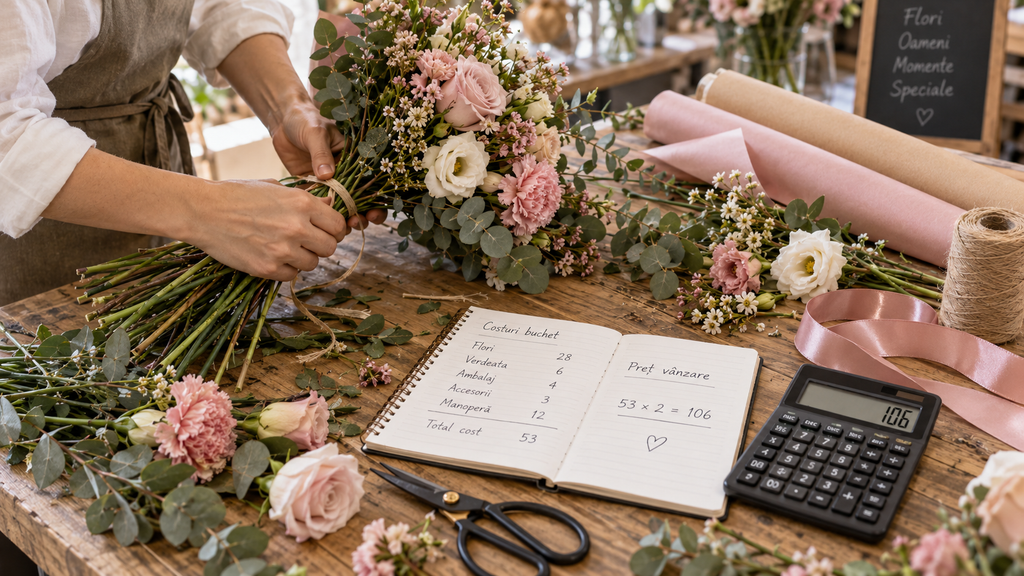
How do you calculate the real cost of a flower stem?
Let’s assume a simple example.
Hypothetical example:
Buy 100 roses with 2 lei / wire.
Total cost:
100 × 2 = 200 lei
If all 100 were marketable, the cost would remain:
2 lei / wire
But suppose, normally for your way of working and your period of analysis, only 90 wires end up being monetized.
The economic cost of the purchased material relative to the 90 marketable yarns becomes:
200 / 90 = 2,22 lei / sold wire
Not a dime.
This difference of about 11% occurs without the supplier changing the price.
If you only get to monetize 80 wires:
200 / 80 = 2,50 lei / sold wire
The economic cost per wire is now 25% higher than the nominal purchase price.
The formula is:
Cost per sales unit = total lot / number of sales units
Important: this is a management analysis of efficiency. From an accounting point of view, abnormal losses should not simply be artificially incorporated into the value of the stock; regulations predict that losses beyond the normal permissible limits are expenses of the period.
For florist management, however, the difference is essential: if you do not measure it, you may think that the product is profitable when losses actually consume the margin.
How do you calculate flowers if you only use part of a pack?
This is one of the real problems of floristics.
The purchase is often made on the link or package, but an order can only use part.
Suppose:
25 wires costs 100 lei.
Nominal cost:
4 lei / wire
The bouquet uses 9 wires:
9 × 4 = 36 lei
If the other 16 wires will be used in other products, 36 lei is a logical allocation.
But if you bought the exclusive variety for a custom order and there’s a good chance the rest can’t be capitalized, the economic analysis changes.
This problem also arises in the discussions of the florists: a specially ordered variety can come in a larger package than the order needs, and the surplus can become a loss.
For custom products, ask:
Does the rest of the package have realistic use?
If so, share the cost.
If not, that order may have to bear a higher share of the purchase cost.
How do you calculate the work of a florist?
The simplest management method is to start at the cost of a productive hour.
Formula:
Cost of productive hour = relevant total cost of flower / realistic number of productive hours
Then:
Manufactured labour = minutes of production / 60 × cost of production time
Do not automatically use all attendance hours as productive hours.
A florist doesn’t spend every minute building products. There are:
- preparation of the workshop;
- flower reception;
- cleaning;
- hydration;
- discussions with clients;
- the recovery of the stock;
- photographs;
- messages;
- preparing orders;
- Cleaning.
The best starting point is measurement.
It timers recurring products for several weeks and builds realistic times.
Hypothetical example:
Domestic cost productive hour: 48 lei.
Bouquet: 15 minutes.
Label:
48 × 15 / 60 = 12 lei
A complex arrangement that takes 60 minutes has 48 lei of labour.
That is why two 100 lei flower products must not necessarily have the same price.
Markup and margin are the same thing?
No.
This is one of the most important differences in the matter.
Suppose:
Cost = 100 lei
Price = 150 lei
Gross profit in this example:
150 & # 8211; 100 = 50 lei
Markup
The addition relates to cost:
Adaos = (Price & # 8211; Cost) / Cost × 100
For example:
50 / 100 = 50%
Margin
The margin relates to the sale price:
Margin = (Price & # 8211; Cost) / Price × 100
For example:
50 / 150 = 33,33%
| Cost | Price | Difference | Adaos | Margin |
|---|---|---|---|---|
| 100 lei | 150 lei | 50 lei | 50% | 33,3% |
If the florist says “I have 50% margin” when in reality he has an added 50%, he significantly overestimates the profitability of the product.
How do you calculate the price if you know the margin you want?
The formula is:
Price = Cost / (1 & # 8211; Margin desired)
If the product costs 100 lei and you want, hypothetically, a margin of 40%:
100 / 0.60 = 166.67 lei
Not 140 lei.
At 140 lei you have an added 40%, but the margin is:
40 / 140 = 28.6%
This is one of the common causes for which a business may seem to apply large additions and still remain with little profit.
What about rent, accounting and software?
It has to be taken into account at business level, but not all of it has to be arbitrarily crammed into the “cost of flowers.”
There are two different questions:
1. How much does it cost me to produce this order?
And
2. How much does my products have to generate for the business to pay all its expenses?
Accounting regulations also distinguish between costs directly related to production and certain administrative or sales costs.
For management, costs such as:
- the rent;
- accounting;
- The software;
- administrative salaries;
- subscriptions;
- General marketing;
- Internet;
- general utilities;
shall be covered by the margin generated by the product portfolio.
That means a bouquet can have positive margin and yet the florist loses money at the end of the month.
Example
You have 40,000 lei the margin of contribution generated by products.
Monthly fixed costs are 45,000 lei.
Products “make money” individually, but business loses:
5,000 lei
That is why two levels of analysis are needed:
profitability of the product And profitability of florariums.
Practical formula for the price of a bouquet
An easy method to apply is:
Step 1. Calculate the cost of marketable flowers
For each ingredient:
Cost of lot / quantity sold × quantity used
Step 2. Add consumables
Paper + ribbon + box + sponge + card + accessories.
Step 3. Add labour
Time × cost of productive time
Step 4. Add other costs directly related to the order
Payment processing, courier packing, channel commission, florist delivery etc.
Result:
Relevant cost of command
Step 5. Calculate price for desired margin
Net price = Relevant cost / (1 & # 8211; desired margin)
The chosen margin is a business decision. There is no such thing as “correct margin for a florist in Romania.”
Example 1: Simple bouquet
All the numbers are hypothetical.
The florist buys 20 wires with 3 lei / wire.
Cost lot:
60 lei
Estimate that 18 will be marketable.
Sales cost:
60 / 18 = 3.33 lei / wire
The bouquet uses 10:
33.30 lei
Other costs:
| Component | Cost |
|---|---|
| Flowers | 33.30 lei |
| Green | 8 lei |
| Supplies | 6 lei |
| Labour | 12 lei |
| Indirect cost of production allocated | 5 lei |
| Total molded cost | 64.30 lei |
We assume, for example, a target margin of 40%.
Price:
64.30 / 0.60 = 107.17 lei
Commercial round at 109 lei:
Difference:
109 & # 8211; 64.30 = 44.70 lei
Modelled margin:
44.70 / 109 = 41.0%
What happens if the wasteer grows?
If out of 20 wires they become vandable only 16:
60 / 16 = 3.75 lei / wire
The 10 wires cost economically:
37,50 lei
Total cost:
68,50 lei
If you keep the price of 107.17 lei, the margin drops to about 36%.
To keep the hypothetical margin 40%:
68.50 / 0.60 = 114.17 lei
The price must be recalculated or the difference must be recovered elsewhere.
Example 2: Premium bouquet
Hypothetical example.
| Component | Cost |
|---|---|
| Premium flowers, adjusted to marketable yield | 110 lei |
| Green | 18 lei |
| Packaging / container | 22 lei |
| Labour | 45 lei |
| Production indirect cost | 12 lei |
| Total | 207 lei |
We assume for the exercise a target margin of 42%.
Price:
207 / 0.58 = 356,90 lei
Difference:
149.90 lei
What if the price of flowers goes up 20%?
The flower component becomes:
110 × 1,20 = 132 lei
New cost:
229 lei
If the sale price remains 356.90 lei, the margin falls from 42% to about 35.8%.
For maintaining the same hypothetical margin:
229 / 0.58 = 394,83 lei
This is the mathematics behind the need to review prices when the purchase changes.
Example 3: Bouquet sold online
The online can add costs that do not exist or are lower in the store.
Full hypothetical example:
| Component | Cost |
|---|---|
| Flowers | 72 lei |
| Green | 10 lei |
| Packaging | 12 lei |
| Labour | 20 lei |
| Production / overhead operational allocated | 8 lei |
| Delivery supported by florist | 20 lei |
| Fixed control cost | 142 lei |
We’re just assuming for example:
- payment processing: 1,2% + 0,50 lei;
- variable purchase / commission cost: 8%;
- target margin after these costs: 30%.
Because two costs are a percentage of the price, the formula becomes:
Price = (fixed costs + fixed fee) / (1 & # 8211; target margin & # 8211; variable percentages)
Price:
142.50 / (1 & # 8211; 0.30 & # 8211; 0.012 & # 8211; 0.08)
= 234,38 lei
At this price:
- Total cost approximately: 164,06 lei;
- difference: 70,31 lei;
- Modelled margin: 30%.
This is why a product may need another online price than direct sales, if the cost structure of the channel is different.
What if you offer 10% discount?
We use the example online above.
Initial price:
234,38 lei
Discount 10%:
MDL 210,94
The percentage costs fall slightly with the price, but the cost of flowers, labour and delivery do not disappear.
In our example, the margin falls from 30% to approximately:
23,2%
10% discount does not automatically mean that profit decreases by 10%.
It can drop much more proportionally.
The general formula is:
Discount margin = [Price × (1- discount) & # 8211; cost] / [Price × (1- discount)]
That’s why the cuts should be simulated before the campaign is launched.
What if the production time doubles?
You estimated 20 minutes for a product.
Actually, it takes 40.
If the productive time costs a hypothetical 48 lei:
Initial estimated work:
16 lei
Real work:
32 lei
You lost 16 lei in the margin of the product without changing a single flower.
Custom products are vulnerable to this very problem.
What if you offer free delivery?
Free delivery is not free for the florist.
It’s just free for the client.
If delivery costs the business 25 lei, there are three possibilities:
- is recovered by the price of the product;
- is recovered from the average value of the basket;
- is supported from the margin.
The third option must be a conscious decision, not a surprise at the end of the month.
How do you calculate prices when flowers change their weekly cost?
You don’t necessarily need to change every price on every bill.
You need a rule.
For recurring products you can use:
- current cost;
- a weighted average cost;
- a regularly revised standard cost;
- a documented buffer for volatility.
From an accounting point of view, stock valuation methods should be applied in accordance with the relevant accounting rules. IAS 2, for example, mentions FIFO or the weighted average cost for interchangeable goods.
For example, the management objective is not to work for months with a cost-based recipe that no longer exists.
A healthy practice is to set an alert threshold:
“If the price of the main ingredients changes above X%, the product enters the review.”
The X-value should be determined by the florist, not copied from a generic benchmark.
Do you have to have the same margin for all the bouquets?
There is no economic rule to enforce that.
Products have different roles.
A product may:
- attract customers;
- had a very large rotation;
- efficiently use flowers that already exist in stock;
- requires very small work;
- use high risk premium flowers;
- requires complex customization;
- generate other sales.
The important thing is to understand each product’s margin and portfolio contributionNot apply the same percentage mechanically without context.
How do you know if the price is too low?
The signals are more objective than the feeling that “seems cheap.”
The price may be too low if:
- does not cover variable costs;
- the margin disappears at a small discount;
- costs increase slightly and the product becomes unprofitable;
- You sell a lot, but cashwork and profit don’t increase;
- very sold products contribute little to fixed costs;
- you did not include labour;
- you did not include normal losses;
- you haven’t updated the cost of ingredients.
How do you know if the price is too high?
A fair cost does not automatically guarantee that the market will accept the price.
If the price required for the product economy is far above what customers are willing to pay, it does not necessarily mean that you have to reduce the margin to zero.
It may mean that the product must be redesigned.
You can modify:
- prescription;
- number of wires;
- varieties;
- packaging;
- working time;
- size;
- Channel for sale.
Sometimes the problem isn’t the price.
It’s the cost of the product.
Why can you have big sales and low profits?
Because turnover is not profit.
You can sell 100,000 lei and have:
- flowers and very expensive materials;
- large losses;
- too many discounts;
- subsidised deliveries;
- uninvoiced labour;
- In addition, the Commission considers that the aid is compatible with the internal market.
- high rent;
- too many low-margin products.
That is why it is useful to watch at least:
net income → product cost → contribution → fixed costs → result
Not just sales.
How does a bouquet recipe help?
A repeatable product becomes much easier to analyze if it has a prescription.
The recipe may contain:
- variety;
- the colour;
- number of wires;
- green;
- consumables;
- the estimated time;
- instructions.
ProFlorist publicly confirms that the products in the catalog can be related to recipes and ingredients and that the system can use information about the inventory of flowers and availability.
This makes an important operational discipline possible: the same product no longer exists only “in the head of the flower.”
The correct price of a bouquet is not a figure copied from the competition and no multiplier chosen from the usual.
It’s the result of an equation:
marketable materials + consumables + labour + channel costs + a sustainable margin.
Then comes the market test.
If math tells you that the product must cost 250 lei, and your client charges it at 150 lei, you don’t solve the problem by ignoring the costs.
You have to rethink the product, recipe, process, channel or positioning.
A healthy florist doesn’t just have to make nice bouquets.
He needs to know how much it costs to make them.
FAQ
How do I calculate the price of a bouquet of flowers?
Calculate the cost of marketable flowers, greenery, consumables, labour and other variable control costs. Then divide the relevant cost at The amount to be reported in column 060 of this row.. For example, if a product costs 120 lei and the hypothetical target is a margin of 40%, the resulting net price is 120 / 0.60 = 200 lei.
Which costs should be added to the flower cost?
There is no universally documented addition for Romanian florists. The necessary addition depends on costs, losses, labor, channel, fixed expenses and positioning. The international sources in the florist industry confirm that the price models differ substantially between businesses.
Markup and margin are the same thing?
No. Adaos relates to the cost, and the margin relates to the sale price. For a product with cost 100 lei and price 150 lei, the addition is 50%, but the margin is 33.3%.
How should wastage be included?
Measuring the marketable yield. If a lot of 100 wires costs 200 lei, but you can realistically monetize 90 wires, the economic cost is 200 / 90 = 2,22 lei per sold wire. But it separates normal losses from abnormal incidents.
How do I calculate the work of a florist?
Calculate the cost of a productive hour and multiply it with the time needed for the product. If the productive hour costs 48 lei and the bouquet takes 30 minutes, the labour is 24 lei.
Do I have to include the rent in every bouquet?
It is not mandatory to artificially assign each rent lion to each product. Instead, the margin generated by the products sold must be sufficient to cover the fixed costs of the florist and to remain profitable.
How do I calculate a custom bouquet?
Build a specific recipe, estimate what quantities must actually be purchased and analyze whether the remaining flowers can be used realistically in other products. Add additional time for discussions, selection, design and execution when it is directly attributable to the project.
How do I calculate the maximum discount?
Start at the price after the discount and recalculate the margin. Don’t decide the exclusive discount as a percentage of the price. A 10% discount can reduce the margin by much more than 10% proportionally.
How do I calculate the price for online?
Includes all the additional costs of the channel: payment processing, commission, packaging, direct marketing and delivery if supported by florist. If some costs are per cent of the price, they must be included in the price equation, not added approximately to the end.
Can I have big sales and yet small profits?
Yeah. The turnover can increase while the margin is consumed by the cost of flowers, wasts, discounts, delivery, wages and overhead. It follows the profitability of the products and the result of the whole business separately.
Related articles
More ideas from the same area

Business & Management / Florists & Stories
How to calculate the real margin on a flower bouquet
A practical method for calculating contribution margin from net revenue and the variable costs…

Business & Management / Florists & Stories
What commercial markup should I apply to flowers?
There is no universal commercial markup that is "correct" for all florists. A multiplier…

Business & Management / Florists & Stories / Supply & Flower Industry
Dignity, professional standards and the future of Romanian floristry: a conversation with the AADF
This article opens a three-part series on Romania’s floristry industry. Drawing on an in-depth…