Why supermarkets distort customers’ perception of flower prices
A low-cost supermarket bunch is not directly comparable with a bespoke arrangement from a local florist. This article considers how sourcing, preparation, design, advice, longevity and service can influence the price.
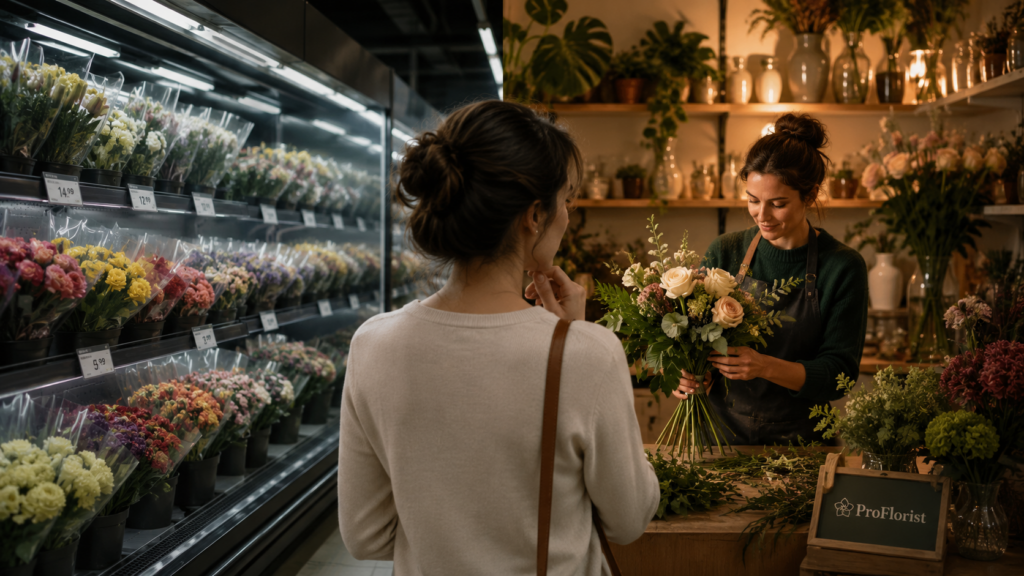
For many customers, the comparison seems simple: in the supermarket I find a small price bouquet, and in a local flower shop the same type of product seems more expensive. The question arises quickly: “Why does it cost more at the flower shop?”
In reality, the comparison is not always correct. The flowers in the supermarket and the flowers in the local flower shop are not sold according to the same logic, do not always have the same quality, do not come from the same types of contracts and are not managed with the same attention. And this difference completely changes the customer’s perception of the price.
The problem isn’t that supermarkets sell flowers. The problem is that, through their purchasing power and their economic model, they can create an unrealistic picture of what “should” cost the flowers.

Flowers are not all the same: quality B2, B1, A2, A1
In the floristry industry, flowers can have different quality degrees. Not all roses, tulips, chrysanthemums or carnations are equal, even though, for the final client, they may appear similar at first sight.
The difference may lie in the stem length, the thickness of the stem, the size of the bud, the stage of opening, the resistance to transport, the uniformity of the lot, freshness or lifetime in vase. A high quality flower will usually have better behaviour after acquisition, a better opening and greater resistance.
In a local florist, the florist often chooses flowers suitable for arrangements, customised bouquets and works that must look good not only at the time of sale but also in the coming days. In the supermarket, the product is often standardised, bought in large quantities and thought for fast rotation.
Here comes the first important difference: the customer visually compares two products that appear similar but are not necessarily of the same quality class.
A1 – high quality
It’s the best quality.
The flowers are uniform, have straight, firm stems, well-formed buds, clean leaves, no visible defects, no bruising, no spots and a good vase life. Usually A1 is the preferred quality for premium florists, events, special bouquets and works where appearance matters a lot.
Example: long rod roses, large head, beautiful opening, uniform batch.
A2 – good quality with minor variations
It’s still good quality, but it can have small differences in uniformity or small imperfections.
Flowers can be very useful in florists, especially for daily bouquets, mixed arrangements or products where not every thread must be perfectly identical. There may be slight differences in length, bud size or shape.
Example: Good roses, but with slightly shorter stems or heads less uniform than A1.
B1 – medium or commercial quality
It’s an acceptable but visible quality below A
Flowers can have shorter stems, smaller buds, more uneven batch, weaker leaves or small defects. They can be used for simple products, promotions, volume bouquets, fast selling or situations where price matters more than perfection.
Example: good flowers to put on the shelf or in affordable bouquets, but not ideal for premium works.
B2 – basic or price-led quality
It’s the lowest quality of the four.
Flowers may have more obvious defects: weak stems, small freshmen, uneven heads, damaged leaves, shorter life, signs of transport or handling. They can be bought for very low price, for promotions, volume or fast consumption, but are not comparable to premium flowers.
Example: Flowers that look acceptable on the shelf, but can hold less and do not offer the same experience as selected flower shop flowers.
In short
A1 = premium, uniform, resistant, very good look.
A2 = good, slightly under premium, suitable for flower shop.
B1 = commercial, medium, more accessible.
B2 = economically, lower quality, low price, shorter duration / aesthetic.
Supermarkets buy differently from local florists
A small or medium flower shop does not buy flowers under the same conditions as a large retail chain. Supermarkets can negotiate large contracts, at very large quantities, with prices at which a local florist has no access.
For a large retailer, flowers can only be one of thousands of product categories. For a flower shop, flowers are the main product, the raw material, the image of the business and the direct source of income.
That changes math completely.
The supermarket can buy large volumes, accept very small margins and use flowers as an attraction product. The local florist must cover the cost of flowers, losses, labour, packaging, space, utilities, personnel, transport, taxes and working time of the flower.
When the customer sees a cheap bouquet at the supermarket, he doesn’t see all this difference in economic model.
Flowers can be used as a loss leader
In retail there is the concept of “loss leader ‘: a product sold with very little or even loss in order to attract customers to the store. The customer comes for a product perceived to be very advantageous and, once there, he buys other things.
Flowers can work just like that.
A cheap bouquet, placed at the entrance or in a visible area, creates emotion, seasonality and buying impulse. The customer adds it to the basket with food, drinks, cleaning products or other shopping. For the supermarket, the real value lies not only in the direct profit from the flowers, but in the traffic generated and in the total shopping cart.
For a local flower shop, flowers are not by-products. Flowers are business.
Therefore, the florist cannot compete properly with an actor who can afford to sell flowers as a traffic product, not as a main product.
How promotional prices influence expectations
Here is one of the biggest problems for local florists: supermarkets draw the price perception down.
The customer comes to believe that a bouquet should cost as much as the one seen on the shelf, without taking into account the quality of flowers, freshness, selection, labour, creativity, packaging, consulting, delivery or responsibility of the flower.
In the flower shop, the customer doesn’t just buy flowers. Buy time, experience, taste, selection, care and a product made for an occasion or a specific person.
A florist doesn’t just sell roses. Sell a proper bouquet for an anniversary, a reconciliation, a wedding, a baptism, a final homage or an important moment. And this difference isn’t always seen in the price on the shelf.
Flowers are perishable products, not simple decoration objects
In a flower shop, flowers are constantly taken care of: change the water, cut the rods, clean the leaves, check the opening stage, discard the damaged flowers, keep the right temperature and prepare each order.
In the supermarket, at least in Romania, flowers sometimes happen to be left without water, placed in inappropriate areas or managed by personnel who have no flower training or dedicated time for perishable products. Not because people don’t want to, but because the system isn’t built around flowers.
Flowers need daily attention. There’s no cans, there’s no detergents, there’s no products that can sit on the shelf anyway. If neglected for a few hours or a day, their quality decreases visibly.
In other countries, some supermarkets have better developed systems for flower products: dedicated staff, clear flows, correct hydration and specially designed areas. In Romania, this difference is not always present, and the customer can end up buying cheaper flowers with shorter lifespan.
Local florists offer a different kind of value
Local florist can’t and shouldn’t just compete on the price. Her power lies elsewhere. It stands in selection, freshness, relationship with the client, personalisation, recommendations, careful delivery, in adapting the bouquet to the budget and occasion, in the fact that the product is made by a man who understands flowers.
A bouquet from the flower shop can be adjusted: more romantic, more elegant, happier, more sober, more premium, more natural, more suitable for a particular recipient. The florist can explain what flowers resist, what combinations are suitable, what colours a particular message sends and what can be achieved in the client’s budget. This value does not go into a simple comparison with a standard supermarket bouquet.
Why clear customer information matters
Local florists need to explain these differences more often, without attacking supermarkets and without appearing defensive. The client is not guilty of making comparisons. He compares what he sees.
When a supermarket bunch costs far less than a florist-made bouquet, the customer needs context to understand the difference.
And the context can be explained simply:
- Flowers can have different qualities.
- Supermarkets buy big volumes.
- Sometimes flowers are used as a product of attraction.
- The florist works with losses, labour, care and personalisation.
- A bouquet made by the florist is not the same as a standard shelf bouquet.
Customer education should not be done aggressively. It needs to be done constantly, calmly and clearly.
The core issue: different business models
Local florists compete with an actor who does not have the same economic logic.
For the supermarket, flowers can be a small category, a seasonal product, a traffic product or a basket supplement. For the flower shop, flowers are the centre of activity. That’s where the imbalance comes from.
Local florist can’t buy at the same volumes, can’t sustain the same small margins, can’t use flowers as a simple product of attraction and can’t afford to sell constantly in loss just to bring traffic.
Therefore, the strict price comparison is incomplete.
The client should also compare quality, freshness, lifetime, service, personalisation, delivery and experience.
How local florists can respond
Florists must not enter an impossible fight with supermarkets at the lowest price. It would be a trap.
Instead, I can better communicate what distinguishes them:
- carefully selected flowers;
- custom-made bouquets;
- real consultant;
- local delivery;
- adaptation to the occasion;
- fair care of flowers;
- personalised products;
- direct relationship with the client;
- supporting a local business.
Local florists need to become more visible, clearer and present where the customer seeks: online, in local applications, on Google, on social media and in the community of her city.
The role of ProFlorist
ProFlorist is designed to support local florists and help customers discover verified professionals where coverage is available. The idea is not to compete with the supermarket at minimum price, but to bring to the customer the real value of the flower shop: freshness, care, experience, personalisation and local delivery.
For customers, ProFlorist is intended to help them discover verified local florists where coverage is available. For florists, the platform can provide an additional visibility channel, subject to the published commercial terms.
Florists need technology, but also a common voice. They need to explain better what they sell, why quality matters and why a bouquet created by a florist cannot be reduced to comparison with a supermarket product.
Supermarkets did not invent the price problem, but they strongly changed the customer’s perception of flowers. Through large volumes, prices hard to access for small florists and the possibility to use flowers as a traffic product, the large retail creates an unbalanced comparison.
Local florists don’t just sell flowers. Sell selection, care, time, creativity and responsibility.
And if we want a healthy floristry industry, we need to talk more about these differences. Calm, clear and assumed.
Because flowers aren’t all the same. And the economic model behind them is not the same.
Related articles
More ideas from the same area
Business & Management / Florists & Stories / Supply & Flower Industry
Beyond floral beauty: standards, identity and the future of Romania’s floristry industry
A Romania-focused discussion with the Association of Romanian Florist Entrepreneurs about professional standards, market…

Education & Floral Design / Events & Community / Supply & Flower Industry
Gateway to the Americas Cup: Ioana Nechifor on the international stage
The Gateway to the Americas Cup has brought respected floral designers from different countries…
Business & Management / Florists & Stories / Supply & Flower Industry
Dignity, professional standards and the future of Romanian floristry: a conversation with the AADF
This article opens a three-part series on Romania’s floristry industry. Drawing on an in-depth…