Software & Digitalisation / Supply & Flower Industry
Floristry enters the AI era: from the greenhouse and supply chain to florist and customer
Artificial intelligence is beginning to influence the flower industry, from crop planning and distribution to wholesaling, florist operations and customer service. This article examines the possibilities carefully, without treating emerging tools as proven replacements for professional judgement.
Artificial intelligence is no longer a subject reserved for technology companies. In 2026, AI began to appear more and more clearly in the flower industry, from production and crop planning to distribution, wholesalers’ activity, florist marketing and relationship with the final customer.
The signal is important for professionals in the field, because we are not just talking about the emergence of new digital tools. We are talking about a broader change in the way the entire floral industry organises its operations, takes decisions and communicates.
Two important professional events in 2026 look very good in this change. In the United States, WFFSA DevX 2026 dedicated a full day to the application of artificial intelligence in the activity of floral industry companies. In Colombia, SECTION 2026 include in the programme artificial intelligence, automation and agriculture 4.0, including examples of the use of AI agents in real operations in the flower sector.
Calendar of Europe’s major flower and wedding fairs: autumn 2026 – early 2027
For florists and floral designers, the message is simple: The digitisation of industry is accelerating, and AI is starting to shift from experiment to business tool.
Almost 70 flower-industry professionals discussed AI in Atlanta
WFFSA – Wholesale Florist & Florist Supplier Association – is one of the main professional organisations dedicated to floral distribution and suppliers in the United States.
From 28 to 31 July 2026, the organisation conducted DevX 2026, a professional development programme for the floral distribution industry in Atlanta. The event almost brought together 70 professionals, according to WFFSA communication.
One of the core elements of the program was artificial intelligence.
WFFSA dedicated a full day application of AI in professional activity through a workshop built for participants with different levels of experience, from beginners to professionals who already use such technologies. The stated goal was to discover practical applications and collaborative tools that can be integrated into business.
The fact that an organisation dedicated to wholesalers and flower suppliers introduces AI as the central theme of vocational education says a great deal about market direction.
No more discussion of the question “will AI enter the flower industry?”
The relevant question becomes:
“Where can AI be used to make the flower business more efficient?”
AI doesn’t mean the florist will be replaced
This is probably one of the most common fears when we talk about artificial intelligence.
In the floral industry, this idea is all the more sensitive as florica is a deeply creative activity based on experience, aesthetic sensitivity, product knowledge and the relationship between people.
WFFSA itself addressed this issue in an analysis dedicated to the impact of AI on jobs in the flower industry.
The organisation concludes that relations, knowledge of products, instinct, trust and services offered to customers remain deeply human. Instead, IA can take over or accelerate a number of administrative and repetitive activities that take time and prevent people from focusing on selling, solving problems and relationships with customers.
For a florist, the difference is important.
AI should not be seen as a substitute for creativity, but as a replacement for creativity. Digital assistant.
The florist continues to create. But technology can help him work faster. Software for florists
From greenhouse to customer: AI begins to enter the entire floral chain
The flower industry has one of the most complex supply chains.
A flower may be produced in the greenhouse from Kenya, Ecuador, Colombia or the Netherlands, bought through an auction or digital platform, transported through a refrigerating chain, distributed to the wholesaler, purchased by the florist and converted into the product the customer receives.
There are data and decisions at each of these stages.
And this is exactly where the AI opportunity comes in.
The scheme shall become:
grower → supply chain → wholesale → florist → marketing → curator
1. AI in Flower Production
At grower level, artificial intelligence can be used to analyse greenhouse data and support production decisions.
A 2026 academic study on the integration of Large Language Models into floricola production analyses, for example, how data such as temperature, humidity, light, fertility, costs and labour planning can be integrated into a decision-making support system. Research uses orchid production in the greenhouse as an example.
This means that AI can become part of a system that helps producers understand what is happening in culture more quickly and react to changes.
2. Colombia puts AI directly on the floriculture agenda
One of the most interesting examples comes from Colombia, one of the most important flower producing and exporting countries in the world.
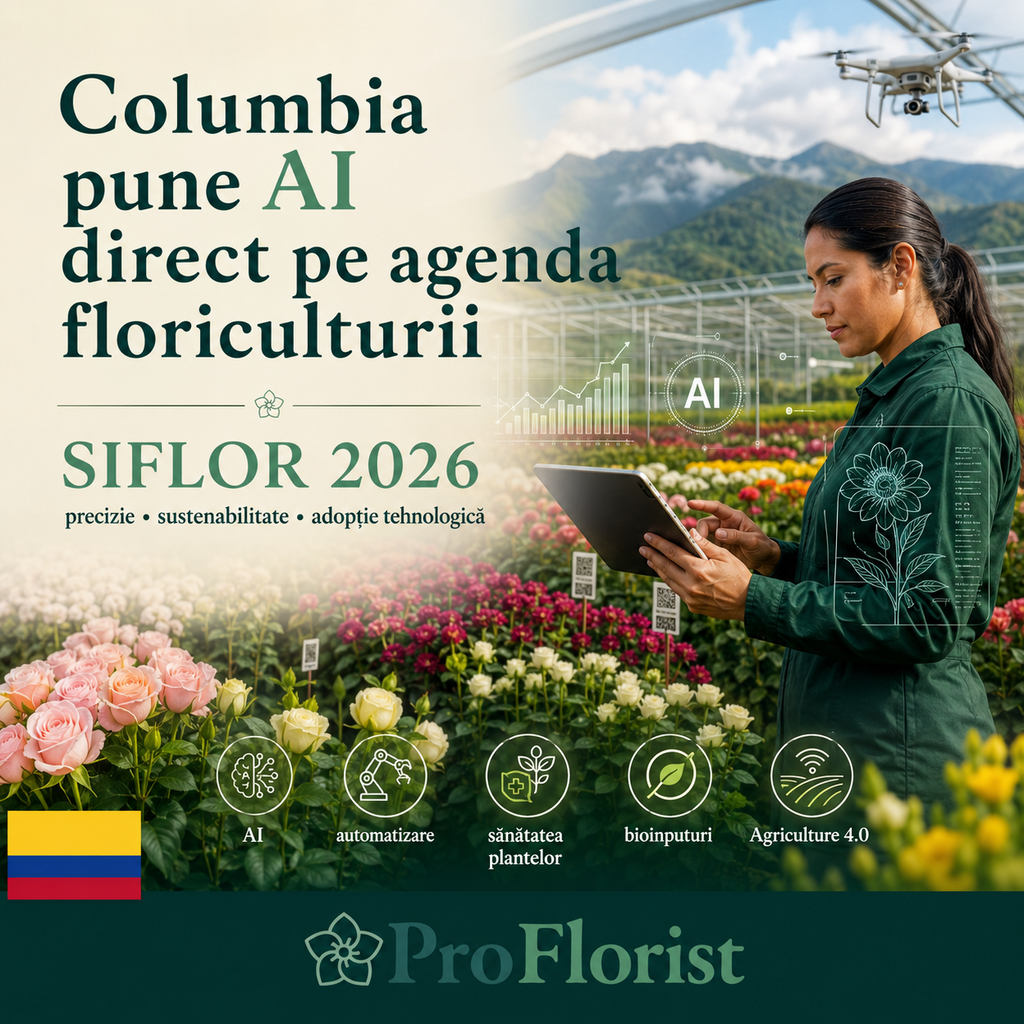
SIFLOR 2026 – Simposio Internacional de Floricultura, organized by Asocolflores and Ceniflores, will take place on 18 and 19 November 2026, in Rionegro, Antioquia.
Organizers describe industry as entering a period defined by accuracy, sustainability and technological adoption. The agenda includes artificial intelligence, automation, plant health, bioinputs and Agriculture 4.0.
Two presentations are particularly interesting.
Javier Alberto Chaparro will address the use of artificial intelligence for detection of phenological stagesand Jerónimo Herrera Carbonell will discuss AI agents influencing real operations in the flower sector.
There will be a dedicated panel Automation and Agriculture 4.0.
It is an important step: AI is no longer in an overview of technology, but is analysed in relation to concrete processes in agricultural production and floricola.
3. AI can help plan production and estimate demand
In the flower industry there is a fundamental difficulty: the product is perishable.
You can’t produce unlimited quantities and then keep the merchandise in a warehouse for months.
There must be a permanent balance between:
production, demand, season, price and logistics.
A 2026 USDA report on the floricola industry in Colombia notes that technology adoption is accelerating and AI-based systems are already being used for crop planning and demand forecasting, both at the level of Colombian farms and in the procurement operations of international retailers. The aim is to bring production closer to real market signals and reduce losses.
For the flower industry, this can have an enormous impact.
If the manufacturer better estimates the application for Valentine’s Day, Mother’s Day, wedding season or other important periods, it can reduce both deprivation and overproduction.
4. AI and supply chain of flowers
Transport is another area where data technology and analysis can become decisive.
Flowers sometimes travel thousands of miles, and every hour can count for quality and life vessels.
Air transport is fast but expensive and has a higher carbon footprint. Maritime transport is slower but can be significantly more efficient for certain varieties.
A study published in Journal of Clean Production in 2026 analysed an optimisation system for a Kenyan exporter of flowers and showed that a combined air and maritime transport strategy could reduce emissions considerably, with relatively low cost increases in the model under consideration.
It doesn’t mean that AI will decide how each flower should be transported.
However, it means that very large volumes of data can be analyzed more quickly to find better combinations between:
cost + time + quality + risk + sustainability.
5. The wholesaler is getting more digital
For wholesalers, AI can probably have one of the fastest effects.
A flower warehouse permanently manages hundreds or thousands of products, varieties, lots, prices, orders and customers.
AI can help analyse sales history, identify fast moving products, prepare offers, communicate with customers and estimate the need.
A system may observe, for example, that during a certain period the controls for white hydrangeas, garden roses or eucalyptus increase and signal this change to the buyer.
The final decision remains with the professional, but the information can get to him faster.

6. For the florist, the biggest changes can come in daily activity
At the florist level, artificial intelligence must not be complicated.
The most useful applications are probably exactly the ones that save time.
A florist can use AI to:
- drawing up product descriptions and texts for the online store;
- preparing posts for social media;
- structure of offers for weddings and events;
- generating variants of emails and responses to customers;
- analysis of sales data;
- quick translation of materials;
- organising ideas for campaigns;
- preparing an editorial calendar;
- brainstorming for collections, concepts and names;
- automation of repetitive customer questions.
In a small flower shop, where the same person can be on the same day florist, buyer, photographer, social media manager, salesperson and administrator, a few hours saved weekly can become very important.
7. Floral marketing will probably change the fastest
Here AI is already very easy to access.
Florists can generate ideas for campaigns, heads, descriptions, articles, newsletters or videos in a much shorter time.
But there’s a trap.
If all florists use the same tools in the same way, the result can be a marketing that starts to look the same.
Therefore, the advantage will not come from “using AI.”
The advantage will come from the way you use it.
The brand, real photography, flower style, company voice, portfolio and customer experience will become even more important.
AI can speed up communication, but it can’t invent the authenticity of a business that has no identity.
8. Customer floral service can become permanently available
Another important change will be the interaction between the customer and the florist.
Customers are increasingly used to getting answers immediately.
“Do you have peonies?”
“Can you deliver tomorrow?”
“What flowers are available for a wedding in September?”
“Can I order 100 white roses?”
“What is the difference between these two variants?”
Some of these questions can be taken over by digital assistants connected to the real information of the florist.
However, it is important that technology does not invent availability, prices or conditions.
A good system must be connected to the correct data and know when to transfer the conversation to a human.
9. How might AI assist a floral designer?
Yes, but his role must be understood correctly.
AI can help brainstorming, moodboards, structure concepts or explore visual directions.
But there is a huge difference between a spectacular image generated on the screen and the real possibility of building that installation.
A floral designer must know:
what flowers are there, what season they are, how much they cost, how they behave without water, how they weigh the structure, how they carry it, how long the installation lasts and how it will look after six hours in a heated room.
These things come from experience.
Therefore, in floral design, AI should be regarded as a tool for exploring ideasNot as a substitute for professional knowledge.
10. Data becomes one of the most important resources of the flower shop
Maybe the biggest change is not AI itself.
It is that floral businesses are beginning to understand the value of the data.
If you have a good digital system, you can start answering questions like:
What are the most profitable products?
What varieties sell best every month?
How many customers are coming back?
What is the average value of an order?
What products are ordered together?
What campaign generated sales?
How many offers for weddings turns into a contract?
How many hours are required to produce a certain category of arrangements?
Without data, AI has very little to work with.
For this reason, Business digitisation must come before intelligent automation.
Flowers for weddings and events support demand even when the retailing slows down
11. The future flower will not necessarily be less human
There is even the possibility that the opposite will happen.
If automation eliminates some of the repetitive activities, the florist can spend more time exactly where it creates the highest value:
with the client, with the flowers and with the design.
Instead of spending two hours writing texts, he can work on the collection.
Instead of manually searching for information in several files, it can receive a summary.
Instead of answering the same administrative question for the fifteenth time, he can discuss the concept of his wedding with a client.
This is probably the healthiest perspective on AI in floristics:
not technology instead of man, but technology that lets man do more of what he knows best to do.
10 cut flowers that last long in vase and how you prolong their lifespan
12. From greenhouse to florist: the flower industry becomes connected
What happens at WFFSA DevX in the United States and what SIFLOR is preparing in Colombia shows that this transformation is not isolated.
The producers are talking about AI.
The Wholesalers are talking about AI.
Supply chain becomes digital.
Retailers use data.
Florists begin to automate marketing and communication.
The customer gets used to faster digital services.
The industry thus turns into a connected ecosystem:
grower → supply chain → wholesale → florist → marketing → curator.
And over the next few years, perhaps the difference between floral businesses will not be given by who uses the technology, but by who manages to combine it with human experience and true knowledge of flowers.
AI & Technology in the Floral Industry – a topic worth bringing on stage
The transformation is important enough that technology and artificial intelligence are no longer treated as secondary subjects in the industry’s professional events.
At flowerX 2027 – European Floral & Event Design Summit, a conversation about “AI & Technology in the Floral Industry – from greenhouse to custodian” could put at the same table producers, wholesalers, florists, technological platforms, eCommerce specialists and marketing professionals.
Because the question is no longer whether the flower industry will become digital.
The transformation has already begun.
And for florists, this can be one of the most important opportunities of the following years: to use technology to build more efficient businesses without losing exactly what makes floristics special – creativity, emotion and the relationship between people.
Related articles
More ideas from the same area

Business & Management / Software & Digitalisation
What do you check for a flower shop program if you work from your phone and computer
What you check in a flower shop program on phone and computer: orders, roles,…

Business & Management / Software & Digitalisation
Invoicing, inventory or florist management software: what each system does
The difference between invoicing, management and florist management. How documents, stock, orders and production…

Business & Management / Software & Digitalisation
Excel or flower-shop software? Comparing organisation, costs and limitations
A practical comparison of spreadsheets and dedicated flower-shop software. Product functions, packages and availability…